


Global death toll: 1 million premature babies every year
Related images
(click to enlarge)
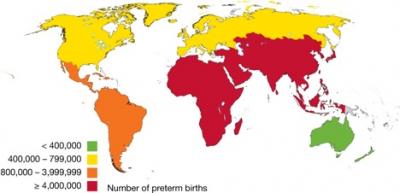
More than one million infants die each year because they are born too early, according to the just released White Paper, The Global and Regional Toll of Preterm Birth. The new White Paper shows that in 2005, an estimated 13 million babies worldwide were born preterm -- defined as birth at less than 37 full weeks of gestation. That is almost 10 percent of total births worldwide. About one million deaths in the first month of life (or 28 percent of total newborn deaths) are attributable to preterm birth.
According to the White Paper, the highest preterm birth rates in the world are found in Africa, followed by North America (United States and Canada combined).
These data are being presented at the 4th International Conference on Birth Defects and Disabilities in the Developing World to be held in early October in New Delhi, India.
"Premature births are an enormous global problem that is exacting a huge toll emotionally, physically, and financially on families, medical systems and economies," says Dr. Jennifer L. Howse, president of the March of Dimes. "In the United States alone, the annual cost of caring for preterm babies and their associated health problems tops $26 billion annually.
"If world leaders are serious about reaching the United Nation's Millennium Development Goals to reduce child mortality and improve maternal health, then strategies and funding for reducing death and disability related to preterm birth must receive priority," Dr. Howse adds.
An Uneven Global Problem
The new White Paper uses data published recently in The Bulletin of the World Health Organization (WHO). The March of Dimes says the WHO Bulletin figures are conservative –counting only singleton preterm births, for example– and likely underestimates the true magnitude of the worldwide crisis of preterm birth.
Worldwide, the preterm birth rate is estimated at 9.6 percent –representing about 12.9 million babies. Though all countries are affected, the global distribution is uneven: the toll of preterm birth is particularly severe for Africa and Asia, where more than 85 percent of all preterm births occur. Comparison of preterm birth rates across world regions finds the highest rate in Africa -- 11.9 percent or about 4 million babies each year; followed by (in descending order) North America, Asia, Latin America and the Caribbean, Oceania (Australia and New Zealand combined), and Europe. See chart below for more information.
Increase in Preterm Births
Wherever trend data are available, rates of preterm birth are increasing. For example, the rate of preterm birth in the U.S. has increased 36 percent in the past 25 years. Key factors contributing to this increase include a rise in the number of pregnancies in women over age 35; the growing use of assisted reproduction techniques, leading to an increase in the number of twin and higher order multiple births; and the rise in the number of late preterm births (defined as between 34 and 36 weeks gestation).
Babies who survive a preterm birth face the risk of serious lifelong health problems including cerebral palsy, blindness, hearing loss, learning disabilities, and other chronic conditions. Even infants born late preterm have a greater risk of re-hospitalization, breathing problems, feeding difficulties, temperature instability (hypothermia), jaundice and delayed brain development.
Underlying Causes and Risk Factors
There are some known risk factors for preterm birth that can be identified before or during pregnancy. For example, women who have already had one preterm baby are at greater risk. Some preterm births may be preventable by addressing known modifiable risk factors, including:
- Nutrition and body weight;
- Existing medical conditions such as high blood pressure and diabetes;
- Alcohol and tobacco use, and secondhand smoke;
- Early elective inductions and elective Cesarean delivery.
However, at present, there is no reliable way to prevent or delay preterm birth, says Christopher P. Howson, Ph.D., vice president for Global Programs of the March of Dimes. "While much can be done right now to reduce death and disability from preterm birth even in low-resource settings, we need to know more about the underlying causes of premature birth in order to develop effective prevention strategies," he says.
The March of Dimes and the other authors of the white paper call for greater efforts to inform health professionals, policy makers, women of childbearing age, and others about the worldwide toll of preterm birth and opportunities for prevention and for care of women with high-risk pregnancies and their babies.
Preterm Births: Why Don't They Count?
Few countries currently have good health statistics and information systems or birth surveillance registries, the authors of the white paper say, so data on the number of preterm births and related deaths are limited at best.
"This was a first attempt to estimate the worldwide scale of the problem," says Mario Merialdi, M.D., of WHO's Department of Reproductive Health and Research, one of the editors of the White Paper and an author of the study published in The Bulletin of WHO. "As a first step, it is necessary to improve data on the extent of the problem." He says WHO currently is improving its database on preterm birth in order to support decision-making in this area.
Another challenge, the authors of the white paper say, is that there is no internationally accepted classification of preterm birth or glossary of terms. "We need to at least adopt common definitions and agree on what is a preterm baby," says Joy E. Lawn, MRCP, of Saving Newborn Lives/Save the Children USA.
Dr. Lawn says there also is an urgent need for more country and regional data on the prevalence of acute and long-term health problems and impairment caused by preterm birth.
Source: March of Dimes Foundation
Other sources
- Study: 2 million babies and mothers die at birthfrom PhysorgWed, 7 Oct 2009, 9:21:15 UTC
- Study: 2 million babies and mothers die at birthfrom AP HealthWed, 7 Oct 2009, 0:56:12 UTC
- Global death toll: 1 million premature babies every yearfrom Biology News NetMon, 5 Oct 2009, 5:42:09 UTC
- Early Births Take a Toll, Group Saysfrom NY Times HealthMon, 5 Oct 2009, 5:28:08 UTC
- Preterm births on rise: reportfrom CBC: HealthSun, 4 Oct 2009, 22:56:06 UTC
- Global Death Toll: One Million Premature Babies Every Yearfrom Science DailySun, 4 Oct 2009, 19:28:15 UTC
- Global death toll: 1 million premature babies every yearfrom PhysorgSun, 4 Oct 2009, 17:21:41 UTC