


Current hepatitis C treatments work equally well, UT Southwestern and national researchers report
Related images
(click to enlarge)
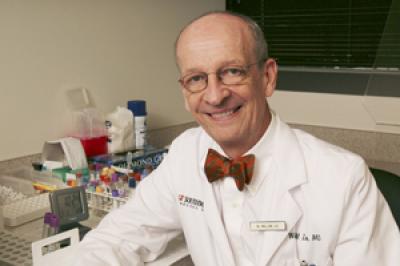
The three treatment combinations for clearing the most common form of the hepatitis C virus work equally well with similar side effects, UT Southwestern Medical Center researchers and their colleagues in 13 other institutions have found. Hepatitis C affects nearly 4 million Americans and leads to cirrhosis and liver cancer but can be arrested permanently in many patients. Results of the two-year study, called the Individualized Dosing Efficacy vs. Flat Dosing to Assess Optimal Pegylated Interferon Therapy (IDEAL) Trial, are available online and in today's print issue of The New England Journal of Medicine.
Researchers compared a standard dose of the long-acting form of interferon alpha with a lower dose and against a different long-acting interferon alfa preparation. Each achieved about 40 percent clearance of the virus.
"It doesn't seem to make any difference which treatment a physician gives a patient," said Dr. William M. Lee, professor of internal medicine at UT Southwestern and a principal investigator of the study. "These standard treatments were shown to be equally successful when used in combination with the drug ribavirin to treat hepatitis C, so the comparison needed to be done."
Hepatitis C is the most common reason for liver transplantation in the U.S., and there currently is no vaccine to prevent hepatitis C infection.
The IDEAL Trial, conducted between March 2004 and June 2006, included 3,070 patients with the most common and difficult to treat form of hepatitis C virus infection. Participants, who had not received prior treatment, were assigned randomly to groups that received one of the three treatments: a standard dose of peginterferon alfa-2b, a low dose of peginterferon alfa-2b, or peginteferon alfa-2a, each in combination with ribavirin. Sixty-five patients were enrolled at UT Southwestern.
Participants received 48 weeks of treatment and then were followed for six months to see if the virus remained absent from blood samples. A patient is said to have achieved sustained virologic response if six months after treatment the virus remains gone. It is then highly unlikely that the virus will return.
Researchers monitored side effects of the interferon medications throughout the study period. Side effects include extreme flu-like symptoms such as fever, chills, fatigue, depression, muscle aches, chest pain, difficulty breathing, nausea, vomiting, and weight and hair loss.
"There wasn't any difference in side effects either," Dr. Lee said.
Although there was little difference overall in treatment results, researchers did find that women achieved higher rates of virus clearance with the standard dose of peginterferon alfa-2b.
Dr. Lee is currently researching new drug agents such as protease and polymerase inhibitors that, in addition to interferon and ribavirin, could improve rates of virus eradication.
Source: UT Southwestern Medical Center
Articles on the same topic
- The hepatitis healing power of blueberry leavesFri, 7 Aug 2009, 15:57:45 UTC
Other sources
- Blueberry leaves may kill hepatitis Cfrom UPIMon, 10 Aug 2009, 21:21:27 UTC
- The hepatitis healing power of blueberry leavesfrom Biology News NetFri, 7 Aug 2009, 22:42:15 UTC
- Hepatitis Healing Power Of Blueberry Leavesfrom Science DailyFri, 7 Aug 2009, 17:21:05 UTC
- The hepatitis healing power of blueberry leavesfrom PhysorgFri, 7 Aug 2009, 15:56:24 UTC
- Current hepatitis C treatments work equally well, researchers reportfrom PhysorgFri, 7 Aug 2009, 14:07:28 UTC
- Current hepatitis C treatments work equally well, UT Southwestern and national researchers reportfrom Science BlogFri, 7 Aug 2009, 14:07:16 UTC