


Astronomers discover stars in early galaxies had a need for speed
Related images
(click to enlarge)
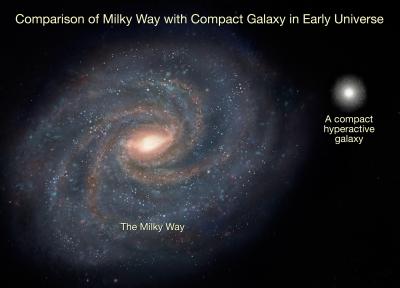
A team of astronomers has measured the motions of stars in a very distant galaxy for the first time and discovered they are whizzing around at astonishingly high speeds—about one million miles per hour, or twice the speed at which the Sun circles our own Milky Way galaxy. The finding offers new insights into how these early galaxies may have evolved into the more familiar ones we see in the nearby universe. The team spent an unprecedented 29 hours observing the galaxy with one of the largest telescopes on Earth—the Gemini South Telescope in Chile—to collect enough light to determine how fast its stars are moving.
Because stars' velocities are directly related to the mass they are orbiting, the ultra-fast speeds would ordinarily suggest the galaxy is very large. But additional observations from the Hubble Space Telescope showed that the galaxy is in fact much smaller than expected, with a diameter of about 5000 light years.
"This result is surprising, as the galaxy itself is extremely small," said Pieter van Dokkum, professor of astronomy and physics at Yale University and lead author of the paper, which appears in the August 6 issue of Nature. "We do find stars with comparable speeds in mature galaxies in today's nearby universe, but those galaxies are typically many tens of thousands of light years across. Here we have a very small galaxy in the young universe whose stars behave as if they were in a giant galaxy."
Because the galaxy is 11 billion light years away, the light it emitted took 11 billion years to reach us on Earth. That means we see the galaxy as it was when the universe was only three billion years old, compared to its current age of 14 billion years.
One of the big riddles is how such extreme galaxies form so quickly, and why we don't see any in today's nearby universe. "It's possible these are the seeds that grow and evolve into the more massive galaxies we see closer to home," van Dokkum said.
The team hopes to look back even further in space and time to see these types of galaxies as they were first forming. "The ancestors of these extreme galaxies should have quite spectacular properties, as they must have formed a huge amount of stars in a relatively short amount of time," van Dokkum said.
Source: Yale University
Other sources
- Astronomers discover stars in early galaxies had a need for speedfrom Science BlogThu, 6 Aug 2009, 14:49:42 UTC
- Astronomers Find Hyperactive Galaxies In Early Universefrom Science DailyThu, 6 Aug 2009, 4:28:20 UTC
- Galaxies of yore smaller, research showsfrom UPIWed, 5 Aug 2009, 21:07:08 UTC
- Speeding Stars Confirm Bizarre Nature of Faraway Galaxiesfrom Live ScienceWed, 5 Aug 2009, 18:49:50 UTC
- Astronomers Find Hyperactive Galaxies in the Early Universefrom PhysorgWed, 5 Aug 2009, 17:42:18 UTC
- Astronomers Find Hyperactive Galaxies in the Early Universefrom Newswise - ScinewsWed, 5 Aug 2009, 17:35:09 UTC
- Speeding Stars Confirm Bizarre Nature of Faraway Galaxiesfrom Space.comWed, 5 Aug 2009, 17:35:06 UTC
- How Strange, Small Galaxies Lost Their Starsfrom Live ScienceTue, 4 Aug 2009, 16:35:12 UTC
- How Strange, Small Galaxies Lost Their Starsfrom Space.comTue, 4 Aug 2009, 16:28:05 UTC