


Toxin detection as close as an inkjet printer
Related images
(click to enlarge)
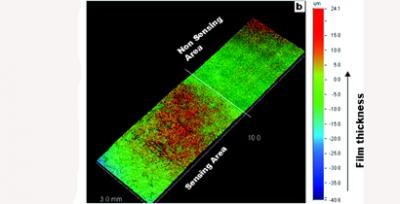
If that office inkjet printer has become just another fixture, it's time to take a fresh look at it. Similar technology may soon be used to develop paper-based biosensors that can detect certain harmful toxins that can cause food poisoning or be used as bioterrorism agents. In a paper published in the July issue of Analytical Chemistry, John Brennan and his research team at McMaster University, working with the Sentinel Bioactive Paper Network, describe a method for printing a toxin-detecting biosensor on paper using a FujiFilm Dimatix Materials Printer.
The researchers demonstrated the concept on the detection of acetylcholinesterase (AChE) inhibitors such as paraoxon and aflatoxin B1 on paper using a "lateral flow" sensing approach similar to that used in a home pregnancy test strip.
The process involves formulating an ink like the one found in computer printer cartridges but with special additives to make the ink biocompatible. An ink comprised of biocompatible silica nanoparticles is first deposited on paper, followed by a second ink containing the enzyme, and the resulting bio-ink forms a thin film of enzyme that is entrapped in the silica on paper. When the enzyme is exposed to a toxin, reporter molecules in the ink change colour in a manner that is dependent on the concentration of the toxin in the sample.
This simple and cost-effective method of adhering biochemical reagents to paper is expected to bring the concept of bioactive paper a significant step closer to commercialization. The goal for bioactive paper is to provide a rapid, portable, disposable and inexpensive way of detecting harmful substances, including toxins, pathogens and viruses, without the need for sophisticated instrumentation. The research showed that the printed enzyme retains full activity for at least two months when stored properly, suggesting that such sensor strips should have a good shelf life.
Portable bio-sensing papers are expected to be extremely useful in monitoring environmental and food-based toxins, as well as in remote settings in less industrialized countries where simple bioassays are essential for the first stages of detecting disease.
Applications for bioactive paper also include clinical applications in neuroscience, drug assessment, and pharmaceutical development.
Source: McMaster University
Other sources
- System created to make paper biosensorsfrom UPIWed, 15 Jul 2009, 21:14:08 UTC
- McMaster researchers 'print' toxin-detecting paperfrom CBC: HealthMon, 13 Jul 2009, 20:21:19 UTC
- McMaster researchers 'print' toxin-detecting paperfrom CBC: Technology & ScienceMon, 13 Jul 2009, 19:56:05 UTC
- Toxin detection as close as an inkjet printerfrom PhysorgMon, 13 Jul 2009, 15:35:15 UTC
- Toxin Detection As Close As An Inkjet Printerfrom Science DailyMon, 13 Jul 2009, 15:28:06 UTC
- Toxin detection as close as an inkjet printerfrom Science BlogMon, 13 Jul 2009, 14:49:07 UTC