


Wolves, moose and biodiversity: An unexpected connection
Related images
(click to enlarge)
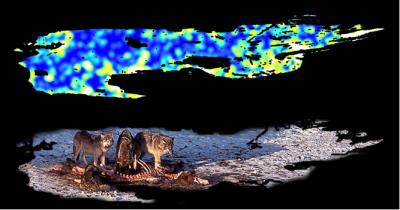
Moose eat plants; wolves kill moose. What difference does this classic predator-prey interaction make to biodiversity? A large and unexpected one, say wildlife biologists from Michigan Technological University. Joseph Bump, Rolf Peterson and John Vucetich report in the November 2009 issue of the journal Ecology that the carcasses of moose killed by wolves at Isle Royale National Park enrich the soil in "hot spots" of forest fertility around the kills, causing rapid microbial and fungal growth that provide increased nutrients for plants in the area.
"This study demonstrates an unforeseen link between the hunting behavior of a top predator—the wolf—and biochemical hot spots on the landscape," said Bump, an assistant professor in Michigan Tech's School of Forest Resources and Environmental Science and first author of the research paper. "It's important because it illuminates another contribution large predators make to the ecosystem they live in and illustrates what can be protected or lost when predators are preserved or exterminated."
Bump and his colleagues studied a 50-year record of more than 3,600 moose carcasses at Isle Royale. They measured the nitrogen, phosphorus and potassium levels in the soil at paired sites of wolf-killed moose carcasses and controls. They also analyzed the microbes and fungi in the soil and the leaf tissue of large-leaf aster, a common native plant eaten by moose in eastern and central North America.
They found that soils at carcass sites had 100 to 600 percent more inorganic nitrogen, phosphorus and potassium than soil from surrounding control sites. Carcass sites also had an average of 38 percent more bacterial and fungal fatty acids, evidence of increased growth of bacteria and fungi.
The nitrogen levels in plants growing on the carcass sites was from 25 to 47 percent higher than the levels at the control sites. Since large herbivores, like moose, are attracted to nitrogen-rich plants, the carcass sites become foraging sites, further supplementing soil nutrients from the urine and feces of the animals eating there.
"I was initially skeptical that it would be possible to detect something as diffuse in the forest floor as nutrients from dead animals," said Peterson, who has been studying the wolves and moose of Isle Royale for decades. "It was gratifying to see Joseph succeed in following animal-derived nutrients back into plants to enrich them in protein, ready to be eaten again."
Even moose killed in winter and mostly consumed produce substantial nutrient hot spots, Bump reports. "At the landscape scale, long-term carcass deposition patterns could influence forest dynamics by shifting competitive relationships among tree seedlings through changes in the nutrient concentrations in their growth environment," he writes.
Bump has observed similar effects on the soil and plant life at elk carcass sites in Yellowstone National Park, another place where wolves are predators and large herbivores are their prey. And he adds that on the Arctic tundra, where soil nutrients are limited, others have found that the impact of a muskox carcass on surrounding vegetation is dramatic even after 10 years.
"Predation and nutrient cycling are two of the most important of all ecological processes, but they seem just about completely unrelated to one another," observes Vucetich. Also on the faculty of Michigan Tech's School of Forest Resources and Environmental Science, Vucetich conducts an annual winter study of the wolves and moose of Isle Royale. "Bump has led us to understand how these two seemingly disparate processes—predation and nutrient cycling—are in fact connected and connected in a most interesting way."
The strong and unexpected connections between wolves, moose and the biogeochemistry of their ecosystem are important to policy makers involved in predator management and to a public increasingly concerned about conservation, Bump suggests.
Source: Michigan Technological University
Other sources
- Wolves, Moose And Biodiversity: An Unexpected Connectionfrom Science DailyTue, 3 Nov 2009, 5:21:14 UTC
- Wolves, moose and biodiversity: An unexpected connectionfrom Biology News NetMon, 2 Nov 2009, 22:28:06 UTC
- Wolves, moose and biodiversity: An unexpected connectionfrom Science BlogMon, 2 Nov 2009, 13:07:22 UTC
- Wolves, moose and biodiversity: An unexpected connectionfrom PhysorgMon, 2 Nov 2009, 8:14:16 UTC
- Wolves, Moose and Biodiversity: An Unexpected Connectionfrom Newswise - ScinewsMon, 2 Nov 2009, 5:35:21 UTC