


NASA spacecraft provides first view of our place in the galaxy
Related images
(click to enlarge)
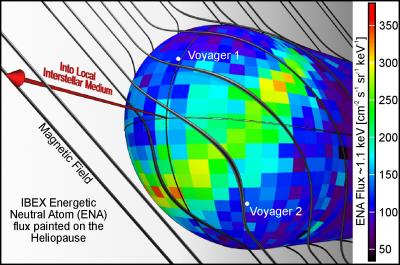
NASA's Interstellar Boundary Explorer, or IBEX, spacecraft has made it possible for scientists to construct the first comprehensive sky map of our solar system and its location in the Milky Way galaxy. The new view will change the way researchers view and study the interaction between our galaxy and sun. The sky map was produced with data that two detectors on the spacecraft collected during six months of observations. The detectors measured and counted particles scientists refer to as energetic neutral atoms.
The energetic neutral atoms are created in an area of our solar system known as the interstellar boundary region. This region is where charged particles from the sun, called the solar wind, flow outward far beyond the orbits of the planets and collide with material between stars. The energetic neutral atoms travel inward toward the sun from interstellar space at velocities ranging from 100,000 mph to more than 2.4 million mph. This interstellar boundary emits no light that can be collected by conventional telescopes.
The new map reveals the region that separates the nearest reaches of our galaxy, called the local interstellar medium, from our heliosphere -- a protective bubble that shields and protects our solar system from most of the dangerous cosmic radiation traveling through space.
"For the first time, we're sticking our heads out of the sun's atmosphere and beginning to really understand our place in the galaxy," said David J. McComas, IBEX principal investigator and assistant vice president of the Space Science and Engineering Division at Southwest Research Institute in San Antonio. "The IBEX results are truly remarkable, with a narrow ribbon of bright details or emissions not resembling any of the current theoretical models of this region."
NASA released the sky map image Oct. 15 in conjunction with publication of the findings in the journal Science. The IBEX data were complemented and extended by information collected using an imaging instrument sensor on NASA's Cassini spacecraft. Cassini has been observing Saturn, its moons and rings since the spacecraft entered the planet's orbit in 2004.
The IBEX sky maps also put observations from NASA's Voyager spacecraft into context. The twin Voyager spacecraft, launched in 1977, traveled to the outer solar system to explore Jupiter, Saturn, Uranus and Neptune. In 2007, Voyager 2 followed Voyager 1 into the interstellar boundary. Both spacecraft are now in the midst of this region where the energetic neutral atoms originate. However, the IBEX results show a ribbon of bright emissions undetected by the two Voyagers.
"The Voyagers are providing ground truth, but they're missing the most exciting region," said Eric Christian, the IBEX deputy mission scientist at NASA's Goddard Space Flight Center in Greenbelt, Md. "It's like having two weather stations that miss the big storm that runs between them."
The IBEX spacecraft was launched in October 2008. Its science objective was to discover the nature of the interactions between the solar wind and the interstellar medium at the edge of our solar system. The Southwest Research Institute developed and leads the mission with a team of national and international partners. The spacecraft is the latest in NASA's series of low-cost, rapidly developed Small Explorers Program. NASA's Goddard Space Flight Center manages the program for the agency's Science Mission Directorate at NASA Headquarters in Washington.
Source: NASA/Goddard Space Flight Center
Other sources
- IBEX Satellite Finds Ribbon-like Structure At Edge Of Heliospherefrom Science Daily15 years ago
- Satellite reveals surprising cosmic 'weather' at edge of solar systemfrom Science Blog15 years ago
- Cassini helps redraw shape of solar systemfrom Science Blog15 years ago
- Cassini Data Help Redraw Shape of Solar System (w/ Video)from Physorg15 years ago
- New View Of The Heliosphere: Cassini Helps Redraw Shape Of Solar Systemfrom Science Daily15 years ago
- Bursting the sun's bubblefrom MIT Research15 years ago
- NASA spacecraft provides first view of our place in the galaxyfrom Science Blog15 years ago
- Spacecraft obtains new view of our galaxyfrom UPI15 years ago
- First IBEX maps reveal fascinating interactions occurring at the edge of the solar systemfrom Science Blog15 years ago
- Catching The Interstellar Wind: Spacecraft Provides First View Of Our Place In The Galaxyfrom Science Daily15 years ago
- Glimpses of Solar System's edgefrom BBC News: Science & Nature15 years ago
- Scientists Explore Galactic Frontier, Release First-Ever All-Sky Map (w/ Video)from Physorg15 years ago
- Mystery Emissions Spotted at Edge of Solar Systemfrom Space.com15 years ago

