


UBC researchers develop new method to study gambling addictions
Related images
(click to enlarge)
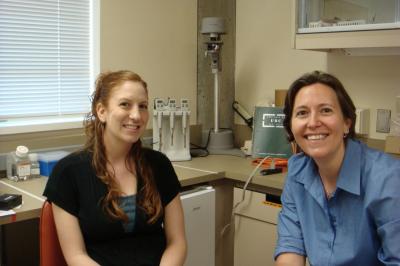
UBC researchers have created the world's first animal laboratory experiment to successfully model human gambling. The advance will help scientists develop and test new treatments for gambling addictions, a devastating condition that affects millions worldwide. In addition to showing that rats can "play the odds," the study finds that gambling decisions can be impaired or improved with drugs that affect brain dopamine and serotonin levels suggesting that these neurotransmitters may moderate gambling behaviour.
"For most individuals, gambling is enjoyable and harmless, but for others, it is as destructive as being addicted to drugs," says Catharine Winstanley, an assistant professor in UBC's Dept. of Psychology, whose study was published today in the Nature journal Neuropsychopharmacology.
"This new model is an important next step because the neurobiological basis of gambling is still poorly understood and few treatment options exist," adds Winstanley, noting that gamblers experience higher rates of divorce, suicide and crime than non-gamblers. "It brings us a step closer to the goal of drug-based treatments for people suffering from gambling disorders."
For the study, rats had a limited amount of time in which to choose between four gambling options which were associated with the delivery of different numbers of sugar pellets. If the animals won the gamble, they received the associated reward. However, if they lost, they experienced a time-out period during which reward could not be earned.
High-risk options offered more potential sugar pellets but also the possibility of more frequent and longer timeouts. Rats learned how to be successful gamblers, selecting the option with the optimum level of risk and reward to maximize their sugar pellet profits.
The study found that rodents treated with drugs that reduced their levels of serotonin levels – associated with impulse control in humans –dramatically reduced their ability to play the odds. A drug that reduced dopamine levels – associated with pleasure in humans – improved their ability to optimize profits. The findings are consistent with recent clinical findings in humans, helping to validate the technique as a model for studying human gambling behaviours.
"We hope this will speed up the development of gambling treatments for humans by giving us a working model to explore drugs and therapies," says Winstanley.
In future studies, Winstanley says she will seek to replicate other aspects of human gambling behaviours, including "loss-chasing" – when a gambler follows a loss with a high-risk gamble – and the "near-miss effect," when a near-win motivates individuals to continue gambling.
Source: University of British Columbia
Other sources
- New Method To Study Gambling Addictions Developedfrom Science DailySun, 21 Jun 2009, 5:35:17 UTC
- Rats Savvy Gamblers, Study Suggestsfrom CBSNews - ScienceThu, 18 Jun 2009, 15:35:18 UTC
- B.C. scientists turn lab rats into problem gamblersfrom CBC: Technology & ScienceWed, 17 Jun 2009, 21:56:04 UTC
- Rats play odds in gambling taskfrom BBC News: Science & NatureWed, 17 Jun 2009, 20:14:10 UTC
- Researchers develop new method to study gambling addictionsfrom PhysorgWed, 17 Jun 2009, 14:35:39 UTC
- UBC researchers develop new method to study gambling addictionsfrom Science BlogWed, 17 Jun 2009, 13:49:30 UTC