


A 3-D view of remote galaxies
Related images
(click to enlarge)
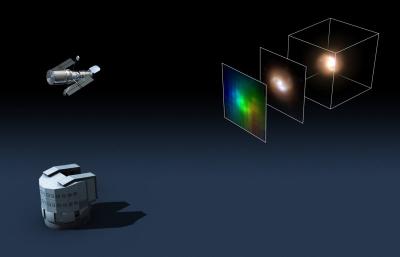
For decades, distant galaxies that emitted their light six billion years ago were no more than small specks of light on the sky. With the launch of the Hubble Space Telescope in the early 1990s, astronomers were able to scrutinise the structure of distant galaxies in some detail for the first time. Under the superb skies of Paranal, the VLT's FLAMES/GIRAFFE spectrograph (ESO 13/02) — which obtains simultaneous spectra from small areas of extended objects — can now also resolve the motions of the gas in these distant galaxies (ESO 10/06). "This unique combination of Hubble and the VLT allows us to model distant galaxies almost as nicely as we can close ones," says François Hammer, who led the team. "In effect, FLAMES/GIRAFFE now allows us to measure the velocity of the gas at various locations in these objects. This means that we can see how the gas is moving, which provides us with a three-dimensional view of galaxies halfway across the Universe."
The team has undertaken the Herculean task of reconstituting the history of about one hundred remote galaxies that have been observed with both Hubble and GIRAFFE on the VLT. The first results are coming in and have already provided useful insights for three galaxies.
In one galaxy, GIRAFFE revealed a region full of ionised gas, that is, hot gas composed of atoms that have been stripped of one or several electrons. This is normally due to the presence of very hot, young stars. However, even after staring at the region for more than 11 days, Hubble did not detect any stars! "Clearly this unusual galaxy has some hidden secrets," says Mathieu Puech, lead author of one of the papers reporting this study. Comparisons with computer simulations suggest that the explanation lies in the collision of two very gas-rich spiral galaxies. The heat produced by the collision would ionise the gas, making it too hot for stars to form.
Another galaxy that the astronomers studied showed the opposite effect. There they discovered a bluish central region enshrouded in a reddish disc, almost completely hidden by dust. "The models indicate that gas and stars could be spiralling inwards rapidly," says Hammer. This might be the first example of a disc rebuilt after a major merger (ESO 01/05).
Finally, in a third galaxy, the astronomers identified a very unusual, extremely blue, elongated structure — a bar — composed of young, massive stars, rarely observed in nearby galaxies. Comparisons with computer simulations showed the astronomers that the properties of this object are well reproduced by a collision between two galaxies of unequal mass.
"The unique combination of Hubble and FLAMES/GIRAFFE at the VLT makes it possible to model distant galaxies in great detail, and reach a consensus on the crucial role of galaxy collisions for the formation of stars in a remote past," says Puech. "It is because we can now see how the gas is moving that we can trace back the mass and the orbits of the ancestral galaxies relatively accurately. Hubble and the VLT are real 'time machines' for probing the Universe's history", adds Sébastien Peirani, lead author of another paper reporting on this study.
The astronomers are now extending their analysis to the whole sample of galaxies observed. "The next step will then be to compare this with closer galaxies, and so, piece together a picture of the evolution of galaxies over the past six to eight billion years, that is, over half the age of the Universe," concludes Hammer.
Source: ESO
Articles on the same topic
- The NASA/ESA Hubble Space Telescope provides new evidence for dark matter around small galaxiesThu, 12 Mar 2009, 14:54:41 UTC
Other sources
- Hubble provides new evidence for dark matter around small galaxiesfrom PhysorgThu, 12 Mar 2009, 15:38:28 UTC
- Galaxies Protected by Dark Matterfrom Space.comThu, 12 Mar 2009, 13:42:29 UTC
- Galaxies Protected by Dark Matterfrom Live ScienceThu, 12 Mar 2009, 13:36:33 UTC
- Hubble Provides New Evidence for Dark Matter Around Small Galaxiesfrom Newswise - ScinewsThu, 12 Mar 2009, 13:36:15 UTC
- A 3-D view of remote galaxiesfrom PhysorgWed, 11 Mar 2009, 2:07:20 UTC
- 3D View Of Remote Galaxies, When Universe Was Half Its Current Agefrom Science DailyTue, 10 Mar 2009, 22:42:06 UTC
- A 3-D view of remote galaxiesfrom Science BlogTue, 10 Mar 2009, 16:39:19 UTC