


Facial expressions of emotion are innate, not learned, says new study
Related images
(click to enlarge)
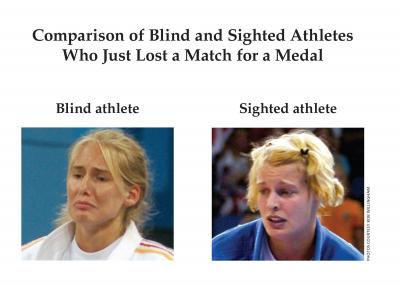
Facial expressions of emotion are hardwired into our genes, according to a study published today in the Journal of Personality and Social Psychology. The research suggests that facial expressions of emotion are innate rather than a product of cultural learning. The study is the first of its kind to demonstrate that sighted and blind individuals use the same facial expressions, producing the same facial muscle movements in response to specific emotional stimuli. The study also provides new insight into how humans manage emotional displays according to social context, suggesting that the ability to regulate emotional expressions is not learned through observation.
San Francisco State University Psychology Professor David Matsumoto compared the facial expressions of sighted and blind judo athletes at the 2004 Summer Olympics and Paralympic Games. More than 4,800 photographs were captured and analyzed, including images of athletes from 23 countries.
"The statistical correlation between the facial expressions of sighted and blind individuals was almost perfect," Matsumoto said. "This suggests something genetically resident within us is the source of facial expressions of emotion."
Matsumoto found that sighted and blind individuals manage their expressions of emotion in the same way according to social context. For example, because of the social nature of the Olympic medal ceremonies, 85 percent of silver medalists who lost their medal matches produced "social smiles" during the ceremony. Social smiles use only the mouth muscles whereas true smiles, known as Duchenne smiles, cause the eyes to twinkle and narrow and the cheeks to rise.
"Losers pushed their lower lip up as if to control the emotion on their face and many produced social smiles," Matsumoto said. "Individuals blind from birth could not have learned to control their emotions in this way through visual learning so there must be another mechanism. It could be that our emotions, and the systems to regulate them, are vestiges of our evolutionary ancestry. It's possible that in response to negative emotions, humans have developed a system that closes the mouth so that they are prevented from yelling, biting or throwing insults."
Source: San Francisco State University
Other sources
- Facial expressions of emotion are innate, not learned, says new studyfrom Biology News NetMon, 29 Dec 2008, 21:56:05 UTC
- Julia Roberts was born with a beautiful smilefrom MSNBC: ScienceMon, 29 Dec 2008, 20:14:09 UTC
- A 'winning' smile is hard-wired into brain: studyfrom CBC: Technology & ScienceMon, 29 Dec 2008, 19:56:04 UTC
- Facial Expressions Of Emotion Are Innate, Not Learnedfrom Science DailyMon, 29 Dec 2008, 14:35:37 UTC
- Facial expressions of emotion are innate, not learnedfrom Science BlogMon, 29 Dec 2008, 12:35:56 UTC
- Smiles and scowls 'in our genes'from BBC News: Science & NatureMon, 29 Dec 2008, 12:14:51 UTC
- Facial expressions of emotion are innate, not learnedfrom Science BlogMon, 29 Dec 2008, 12:14:44 UTC
- Study: Facial expressions of emotion are innate, not learnedfrom PhysorgMon, 29 Dec 2008, 10:42:06 UTC