


NASA renames observatory for Fermi, reveals entire gamma-ray sky
Related images
(click to enlarge)
NASA's newest observatory, the Gamma-Ray Large Area Space Telescope, or GLAST, has begun its mission of exploring the universe in high-energy gamma rays. The spacecraft and its revolutionary instruments passed their orbital checkout with flying colors. NASA announced today that GLAST has been renamed the Fermi Gamma-ray Space Telescope. The new name honors Prof. Enrico Fermi (1901 - 1954), a pioneer in high-energy physics.
"Enrico Fermi was the first person to suggest how cosmic particles could be accelerated to high speeds," said Paul Hertz, chief scientist for NASA's Science Mission Directorate at NASA Headquarters in Washington. "His theory provides the foundation for understanding the new phenomena his namesake telescope will discover."
Scientists expect Fermi will discover many new pulsars in our own galaxy, reveal powerful processes near supermassive black holes at the cores of thousands of active galaxies and enable a search for signs of new physical laws.
For two months following the spacecraft's June 11 launch, scientists tested and calibrated its two instruments, the Large Area Telescope (LAT) and the GLAST Burst Monitor (GBM).
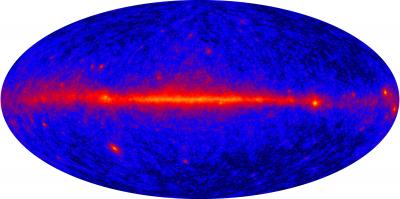
The LAT team today unveiled an all-sky image showing the glowing gas of the Milky Way, blinking pulsars, and a flaring galaxy billions of light-years away. The map combines 95 hours of the instrument's "first light" observations. A similar image, produced by NASA's now-defunct Compton Gamma-ray Observatory, took years of observations to produce.
The image shows gas and dust in the plane of the Milky Way glowing in gamma rays due to collisions with accelerated nuclei called cosmic rays. The famous Crab Nebula and Vela pulsars also shine brightly at these wavelengths. These fast-spinning neutron stars, which form when massive stars die, were originally discovered by their radio emissions. The image's third pulsar, named Geminga and located in Gemini, is not a radio source. It was discovered by an earlier gamma-ray satellite. Fermi is expected to discover many more radio-quiet pulsars, providing key information about how these exotic objects work.
A fourth bright spot in the LAT image lies some 7.1 billion light-years away, far beyond our galaxy. This is 3C 454.3 in Pegasus, a type of active galaxy called a blazar. It's now undergoing a flaring episode that makes it especially bright.
The LAT scans the entire sky every three hours when operating in survey mode, which will occupy most of the telescope's observing time during the first year of operations. These fast snapshots will let scientists monitor rapidly changing sources.
The instrument detects photons with energies ranging from 20 million electron volts to over 300 billion electron volts. The high end of this range, which corresponds to energies more than 5 million times greater than dental X-rays, is little explored.
The spacecraft's secondary instrument, the GBM, spotted 31 gamma-ray bursts in its first month of operations. These high-energy blasts occur when massive stars die or when orbiting neutron stars spiral together and merge.
The GBM is sensitive to less energetic gamma rays than the LAT. Bursts seen by both instruments will provide an unprecedented look across a broad gamma-ray spectrum, enabling scientists to peer into the processes powering these events.
Source: NASA/Goddard Space Flight Center
Articles on the same topic
- GLAST Observatory renamed for Fermi, reveals entire gamma-ray skyTue, 26 Aug 2008, 18:56:27 UTC
Other sources
- First Light from Space Telescope Reveals Gamma-Ray Skyfrom Scientific AmericanThu, 28 Aug 2008, 16:42:08 UTC
- First light for space telescopefrom BBC News: Science & NatureWed, 27 Aug 2008, 19:21:18 UTC
- Gamma-ray telescope renamed after Fermifrom Physics WorldWed, 27 Aug 2008, 17:56:07 UTC
- NASA renames observatory for Fermifrom UPIWed, 27 Aug 2008, 11:42:05 UTC
- First Light from Space Telescope Reveals Gamma-Ray Skyfrom Scientific AmericanTue, 26 Aug 2008, 23:07:29 UTC
- First Light for the Fermi Space Telescopefrom Science @ NASATue, 26 Aug 2008, 22:35:08 UTC
- New Space Telescope Reveals Entire Gamma-ray Skyfrom Science DailyTue, 26 Aug 2008, 21:14:10 UTC
- NASA's Newest Space Telescope Renamed Fermifrom Space.comTue, 26 Aug 2008, 19:42:04 UTC
- NASA Names Telescope After Chicago Scientistfrom Newswise - ScinewsTue, 26 Aug 2008, 19:21:11 UTC
- GLAST Observatory reveals entire gamma-ray skyfrom PhysorgTue, 26 Aug 2008, 18:56:10 UTC