


Scripps scientists will assess Beijing Olympics air pollution control efforts
Related images
(click to enlarge)


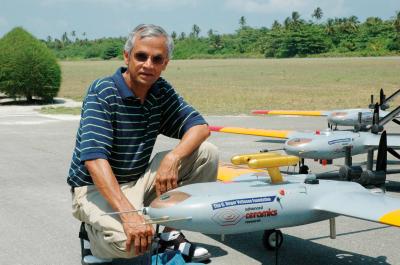
As the Summer Olympics in Beijing kicks off today, the event is affording scientists at Scripps Institution of Oceanography, UC San Diego, a once-in-a-lifetime opportunity to observe how the atmosphere responds when a heavily populated region substantially curbs everyday industrial emissions. The National Science Foundation-funded Cheju ABC Plume-Monsoon Experiment (CAPMEX) will include a series of flights by specially equipped unmanned aircraft known as autonomous unmanned aerial vehicles (AUAVs) that were developed at Scripps. Instruments on the aircraft can measure smog and its effects on meteorological conditions. Data-gathering flights of the aircraft will originate at the South Korean island of Cheju, located about 1,165 kilometers (725 miles) southeast of Beijing and in the projected path of pollution plumes originating in various cities in China including the capital. That information will be combined with concurrent measurements being made by satellites and observatories on the ground that will track the transport of dust, soot and other pollution aerosols that travel from Beijing and other parts of China in so-called atmospheric brown clouds.
The instruments are observing pollution transport patterns as Beijing enacts its "great shutdown" for the Summer Olympic Games. Chinese officials have compelled reductions in industrial activity by as much as 30 percent and cuts in automobile use by half to safeguard the health of competing athletes immediately before and during the games.
"Thanks to the concern of Olympic organizers and the cooperation of the Korean government, we have a huge and unprecedented opportunity to observe a large reduction in everyday emissions from a region that is very industrially active," said Scripps Oceanography climate and atmospheric sciences professor V. Ramanathan, the principal investigator of CAPMEX.
"CAPMEX is going to be the very first UAV campaign in east Asia for air pollution and cloud interaction studies," added CAPMEX field campaign co-principal investigator Soon-Chang Yoon, a researcher at the School of Earth and Environmental Sciences at Seoul National University in Korea. "This will be a very interesting experiment that can never happen again."
Satellite and ground observations began Aug. 1. Pre-inspection test flights are scheduled to begin Aug. 9 and the field campaign is expected to run through Sept. 30.
"Black carbon in soot is a major contributor to global warming," said Ramanathan. "By determining the effects of soot reductions during the Olympics on atmospheric heating, we can gain much needed insights into the magnitude of future global warming."
Ramanathan's team has revolutionized the gathering of atmospheric data through the use of AUAVs that enable researchers to form dimensional profiles of clouds and other atmospheric masses at relatively low cost. The scientists conducted their first successful experiment using AUAV data in the skies over the Indian Ocean during the 2005-2006 Maldives AUAV Campaign. Currently the Scripps researchers are also using the aircraft in the California AUAV Air Pollution Profiling Study, a nine-month-long survey of air pollution over Southern California.
In previous studies, meteorological data gathered by the aircraft helped demonstrate that atmospheric brown clouds can diminish the solar radiation that reaches Earth's surface, warm the atmosphere at low altitudes and disrupt cloud formation. With CAPMEX, scientists hope to improve their ability to deliver such assessments of particulate pollution effects more rapidly and enhance their value as a policymaking tool.
Miniaturized instruments on the aircraft measure a range of properties such as the quantity of soot and size of the aerosols upon which cloud droplets form. The instruments also record variables such as temperature, humidity and the intensity of sunlight that permeates clouds and masses of smog.
For CAPMEX, photonics instruments will be added to the aircrafts' payloads to help calculate the specific contributions of various aerosols to atmospheric heating. Other new instruments such as auto-leveling platforms will enable researchers to improve estimates of how much dimming of sunlight takes place at the ocean surface because of pollution aerosols in the atmosphere.
"Ramanathan's earlier research on atmospheric brown clouds demonstrated their importance in how solar energy is distributed throughout the polluted regions of our atmosphere," said Jay Fein, NSF program director for climate dynamics. "CAPMEX takes his work an important step forward with new innovative micro- and nano-sensor technologies that will provide additional quantitative estimates of solar irradiance, aerosol-cloud interactions, climate forcing and important components of the biogeochemical cycles of the East Asian and western Pacific Ocean region."
Source: University of California - San Diego
Articles on the same topic
- Scientists to assess Beijing Olympics air pollution control effortsFri, 8 Aug 2008, 15:08:48 UTC
Other sources
- Scientists to assess Beijing Olympics air pollution control effortsfrom PhysorgFri, 8 Aug 2008, 15:28:22 UTC
- Astronauts Help Usher in Beijing Olympicsfrom Space.comFri, 8 Aug 2008, 15:28:18 UTC
- Scientists Will Assess Beijing Olympics Air Pollution Control Effortsfrom Newswise - ScinewsFri, 8 Aug 2008, 1:35:06 UTC
- Beijing pollution hits residents not athletes: WHO chieffrom PhysorgThu, 7 Aug 2008, 19:56:12 UTC
- Environmental chemists keep watchful eye on Beijing's smogfrom News @ NatureThu, 7 Aug 2008, 16:14:04 UTC
- The Stranglehold of Weather on Beijing's Air Qualityfrom Live ScienceWed, 6 Aug 2008, 14:14:34 UTC
- Pollution curbs turn Beijing into urban laboratoryfrom PhysorgSun, 3 Aug 2008, 18:56:10 UTC
- Pollution curbs turn Beijing into urban laboratoryfrom AP ScienceSun, 3 Aug 2008, 18:35:05 UTC