


For pandas, there is a mountain high enough, there is a valley low enough
Related images
(click to enlarge)
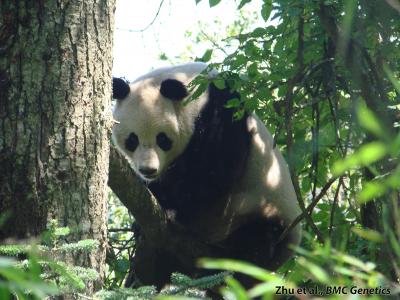
Genetic analysis of giant pandas has shown that features of their landscape have a profound effect on the movement of genes within their population. Researchers writing in the open access journal BMC Genetics found that physical barriers, such as areas lacking bamboo plants and other forest foliage, can separate giant pandas into isolated genetic groups. Fuwen Wei, from the Chinese Academy of Sciences, worked with a team of researchers to study giant pandas in the Xiaoxiangling and Daxiangling mountains. He said, "These results suggest that gene flow will be enhanced if the connectivity between the currently fragmented bamboo forests is increased. This may be of importance to conservation efforts as gene flow is one of the most important factors for maintaining genetic diversity within a species and counteracting the negative effects of habitat fragmentation".
The giant panda is one of the most endangered mammals in the world. This is the first study to demonstrate that there is a relationship between landscape features and gene flow within their population. Wei and his colleagues recovered 192 fecal samples, which were found to come from 53 unique genotypes. These 'genetic signatures' demonstrated signs of fragmentation within the panda population. The researchers said, "It is vital to reconnect the fragmented habitats and increase the connectivity of bamboo resources within a habitat to restore population viability of the giant panda in these regions".
Source: BioMed Central
Articles on the same topic
- Most panda habitat is outside nature reserves according to joint MSU-Chinese researchWed, 28 Jul 2010, 14:29:33 UTC
Other sources
- Panda habitat subject of U.S.-China studyfrom UPIWed, 28 Jul 2010, 22:35:13 UTC
- Most panda habitat is outside nature reserves: researchfrom PhysorgWed, 28 Jul 2010, 21:49:22 UTC
- Panda diplomacy: China to send two to Japanfrom MSNBC: ScienceWed, 28 Jul 2010, 20:07:34 UTC
- Most panda habitat is outside nature reserves, according to joint US-China researchfrom Science DailyWed, 28 Jul 2010, 16:28:15 UTC
- Most panda habitat is outside nature reserves according to joint MSU-Chinese researchfrom Science BlogWed, 28 Jul 2010, 15:35:35 UTC
- Giant panda pair headed for Tokyo zoofrom PhysorgTue, 27 Jul 2010, 18:42:11 UTC
- Giant pandas: Landscape has big effect on movement of genes within populationfrom Science DailyMon, 26 Jul 2010, 1:21:26 UTC
- For pandas, there is a mountain high enough, there is a valley low enoughfrom PhysorgThu, 22 Jul 2010, 23:21:19 UTC