


Ion Tiger fuel cell unmanned air vehicle completes 23-hour flight
Related images
(click to enlarge)
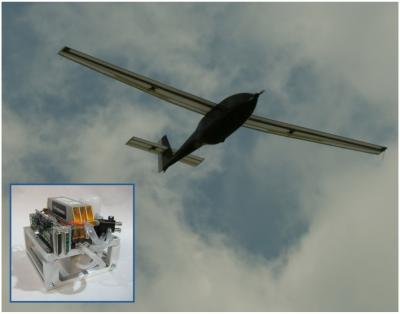
The Naval Research Laboratory's (NRL's) Ion Tiger, a hydrogen-powered fuel cell unmanned air vehicle (UAV), has flown 23 hours and 17 minutes, setting an unofficial flight endurance record for a fuel-cell powered flight. The test flight took place on October 9th through 10th at Aberdeen Proving Ground. The Ion Tiger fuel cell development system team is led by NRL and includes Protonex Technology Corporation, the University of Hawaii, and HyperComp Engineering. The program is sponsored by the Office of Naval Research (ONR). The electric fuel cell propulsion system onboard the Ion Tiger has the low noise and signature of a battery-powered UAV, while taking advantage of hydrogen, a high-energy fuel. Fuel cells create an electrical current when they convert hydrogen and oxygen into water, with only water and heat as byproducts. The 550-Watt (0.75 horsepower) fuel cell onboard the Ion Tiger has about 4 times the efficiency of a comparable internal combustion engine and the system provides 7 times the energy in the equivalent weight of batteries. The Ion Tiger weighs approximately 37 pounds and carries a 4 to 5 pound payload.
Small UAVs are growing in importance for naval missions, as they provide capabilities ranging from surveillance collection to communication links. Electric UAVs have the additional feature of being nearly undetectable from the ground. Due to the high energy in the fuel cell system onboard the Ion Tiger, it is now possible to do long endurance missions with an electric UAV, thus allowing a larger cruise range and reducing the number of daily launches and landings. This provides more capability while saving time and effort for the crew.
In 2005, NRL backed initial research in fuel cell technologies for UAVs. Today, says NRL's Karen Swider-Lyons, "the long endurance flight was made possible by the team's research on high power, efficient fuel cell systems, lightweight hydrogen-gas storage tanks, improved thermal management, and the effective integration of these systems."
Fuel cell technology is being developed to impact the operational spectrum of technologies including ground, air and undersea vehicles and man-portable power for Marine expeditionary missions. "The Ion Tiger successfully demonstrates ONR's vision to show how efficient, clean technology can be used to improve the warfighter's capabilities," comments ONR's Michele Anderson.
Source: Naval Research Laboratory
Other sources
- Hydrogen-Powered Navy UAV Shatters Flight Endurance Recordfrom PopSciTue, 13 Oct 2009, 22:07:04 UTC
- Ion Tiger fuel cell unmanned air vehicle completes 23-hour flightfrom PhysorgTue, 13 Oct 2009, 18:42:24 UTC
- Ion Tiger fuel cell unmanned air vehicle completes 23-hour flightfrom Science BlogTue, 13 Oct 2009, 18:28:34 UTC
- Ion Tiger Takes to the Skiesfrom Live ScienceTue, 13 Oct 2009, 18:14:14 UTC
- Ion Tiger Fuel Cell Unmanned Air Vehicle Completes 23-hour Flightfrom Science DailyTue, 13 Oct 2009, 17:21:13 UTC