


Lotus-plant-inspired dust-busting shield to protect space gear
Related images
(click to enlarge)
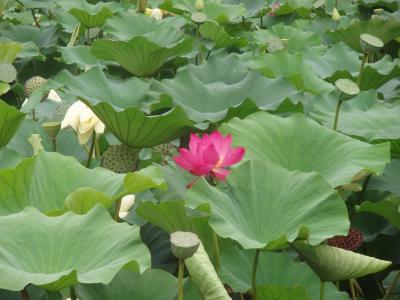

A NASA team is developing a transparent coating that mimics the self-cleaning properties of the lotus plant to prevent dirt from sticking to the surfaces of spaceflight gear and bacteria from growing inside astronaut living quarters. Materials engineers at NASA's Goddard Space Flight Center in Greenbelt, Md., are working to develop a "lotus" coating that can survive the harsh space environment and minimize contaminants from adhering to the surfaces of radiators, spacesuits, scientific instruments, robotic rovers, solar array panels, windows and other hardware used to gather scientific data or carry out exploratory activities during missions.
The technology, which was inspired by the lotus plant that lives along muddy waterways in Asia, was commercially developed as a coating for windows to reduce the need for cleaning. Although a lotus leaf appears smooth, under a microscope, its surface actually contains innumerable tiny spikes. These spikes greatly reduce the area on which water and dirt can attach, preventing them from adhering strongly to the leaf. Water droplets literally roll off, taking mud, tiny insects, and contaminants with them.
The coating, made primarily from silica, zinc oxide, and other oxides, offers countless commercial applications on Earth. It also offers great potential for use in space, particularly on landed missions to Mars or the moon where dust can accumulate on rovers and prevent them from carrying out their missions. Understanding the potential, Northrop Grumman Electronics Systems, Linthicum, Md., teamed with nGimat Corporation, based in Atlanta, Ga., to find more applications for the coating technology, ultimately turning to Goddard for its expertise in making equipment ready to endure the harsh space environment.
"Indeed, the ability to replicate these properties could prove invaluable to NASA," said Wanda Peters, Principal Investigator for NASA's lotus coating research.
During the Apollo moonwalks, for example, such a technology could have prevented the highly abrasive lunar dust from adhering to astronauts' spacesuits. "However, the coating as it was originally formulated will not be able to withstand the harsh environmental conditions found in space," Peters said.
The Goddard team has experimented with and tested different formulas to determine their suitability for spaceflight. "No one formula will meet all our needs," added Peters. "For example, the coating that's applied to spacesuits needs to stick to a flexible surface, while a coating developed to protect moving parts needs to be exceptionally durable to resist wear and tear."
The Goddard team has met with exploration systems engineers at NASA's Johnson Spaceflight Center, Houston, Texas, to demonstrate the modified coatings and get mission requirements.
The team also is trying to partner with Northrop Grumman to add biocide capabilities that would kill bacteria, which thrive and produce foul odors wherever people are confined to a small space for long periods, like the space station. NASA could apply the same biocide-infused coating on a planetary lander to prevent Earth-borne bacteria from adhering and potentially contaminating the surface of an extraterrestrial object. The team believes this version of the coating may have commercial interest to hospitals as well.
"We are modifying and testing the formula to ensure it can withstand all the challenges our hardware will encounter — extreme temperatures, ultraviolet radiation, solar wind, and electrostatic charging. Outgassing of the coating also must be addressed for use inside astronauts' habitation areas," Peters added. "We also are making sure it remains durable and cleanable in the space environment."
"We have a great team," said Peters. "Goddard is the only NASA center researching this type of coating, and we believe continued research will deliver great benefits to NASA's exploration missions and will produce many positive applications outside NASA."
Source: NASA/Goddard Space Flight Center
Other sources
- NASA works on space age coatingfrom UPIThu, 24 Sep 2009, 19:49:25 UTC
- Lotus-plant-inspired Dust-busting Shield To Protect Space Gearfrom Science DailyWed, 23 Sep 2009, 16:28:28 UTC
- Lotus-plant-inspired dust-busting shield to protect space gearfrom Science BlogWed, 23 Sep 2009, 16:07:28 UTC
- Lotus Plant-Inspired Dust-Busting Shield to Protect Space Gearfrom PhysorgWed, 23 Sep 2009, 16:07:15 UTC