


Oil and wildlife don't mix in Ecuador's Eden
Related images
(click to enlarge)
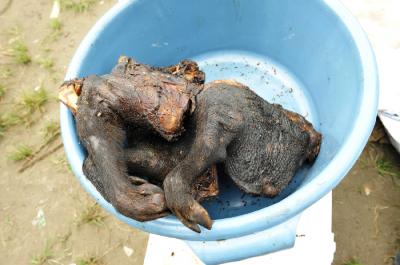
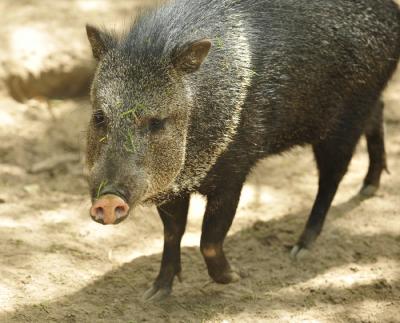
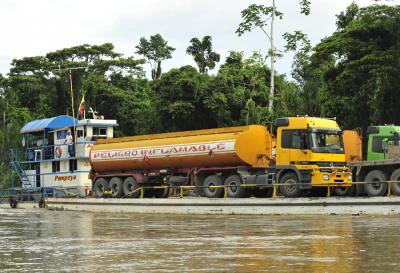
What harm can a simple road do in a pristine place such as Ecuador's Yasuni National Park, home to peccaries, tapirs, monkeys and myriad other wildlife species? A great deal, it turns out. Specifically, it can turn subsistence communities into commercial hunting camps that empty rainforests of their wildlife, researchers from the Wildlife Conservation Society and the IDEAS-Universidad San Francisco de Quito in Ecuador have found. A study by WCS field scientists in the park found that the presence of a single road in a protected area and the subsidies provided by oil companies to local people can fundamentally change how indigenous communities use their resources by providing both access to deeper parts of the forest and a cheap means of getting meat to nearby wildlife markets.
The study appears in the most recent issue of the journal Animal Conservation.
"We've found that a road in a forest can bring huge social changes to local groups and the ways in which they utilize wildlife resources," said WCS and USFQ researcher Esteban Suárez, lead author of the study. "Communities existing inside and around the park are changing their customs to a lifestyle of commercial hunting, the first stage in a potential overexploitation of wildlife."
" A simple, seemingly inoffensive road can have far-reaching effects on a landscape and its people," said Dr. Avecita Chicchón, Director of WCS's Latin America and Caribbean Program. "It provides hunters with more access to a wider range of forest while providing a low-cost transportation route to markets. More importantly, it plugs communities more easily into the larger economic world while creating increased demand for numerous species of animals. It is the road to unsustainability."
In the study, WCS scientists measured the levels of wild meat sold in a market in Pompeya, located about 5 kilometers (3.1 miles) outside Yasuni National Park, between the years 2005-2007. The study also examined the effects of a road constructed in 1992 by oil company Maxus Ecuador Inc. that traverses more than 149 kilometers (92 miles) into the protected area.
The wild meat market emerged shortly after the construction of the road. Although road access was strictly controlled, the oil companies operating this concession provided free travel along the road for hunters from local Waorani communities, according to the study. The availability of cheap transportation is the biggest factor in determining the large amount of wild meat making it to market from Waorani communities. In fact, the road's very existence prompted many Waorani to abandon their semi-nomadic lifestyle; three Waorani communities now live along the road.
The company also hired members of both the Waorani and Kichwa indigenous groups at wages much higher than local salaries, and compensated communities for use of indigenous lands both inside and outside the park. Further, firearms became more widely available to hunters who then abandoned blowguns and other traditional weapons.
Between the years of 2005 and 2007, the researchers recorded more than 11,000 kilograms (24,000 pounds) of wild meat moving through the Pompeya market each year. While the amount of wild meat recorded in the study is still small with respect to other markets, the levels of recorded wild meat sold in Pompeya increased significantly over the study period, rising to over 300 kilograms (661 pounds) of meat per market day in 2007 from approximately 150 kilograms (330 pounds) per market day in 2005.
The majority of animals brought in by hunters were pacas (mid-sized Amazonian rodents), white-lipped peccaries, collared peccaries, and woolly monkeys comprising some 80 percent of the total biomass monitored.
Of the totals recorded at the market, more than 69 percent of the wild meat purchased in Pompeya was bound for restaurants and other markets in other towns, one of which was 234 kilometers (145 miles) away from the first market. Middlemen consistently increased the price of wild meat by up to 60 percent of the original cost paid to hunters. Secondary markets sell wild meat at prices up to two times the average prices of domestic animal meat.
Suarez and his co-authors warn that extractive initiatives in protected areas and wild lands require new governance systems with an emphasis on local participation and increased sensitivity on how development affects the social dynamics of indigenous groups.
Source: Wildlife Conservation Society
Other sources
- Oil And Wildlife Don't Mix In Ecuador's Edenfrom Science DailyMon, 14 Sep 2009, 0:07:37 UTC
- Single road changes life in national parkfrom UPIFri, 11 Sep 2009, 19:07:24 UTC
- Oil and wildlife don't mix in Ecuador's Edenfrom Science BlogThu, 10 Sep 2009, 21:14:25 UTC
- Oil and wildlife don't mix in Ecuador's Edenfrom PhysorgThu, 10 Sep 2009, 19:28:29 UTC