


Telomeres resemble DNA fragile sites
Related images
(click to enlarge)
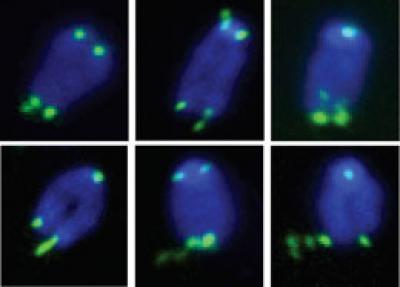
Telomeres, the repetitive sequences of DNA at the ends of linear chromosomes, have an important function: They protect vulnerable chromosome ends from molecular attack. Researchers at Rockefeller University now show that telomeres have their own weakness. They resemble unstable parts of the genome called fragile sites where DNA replication can stall and go awry. But what keeps our fragile telomeres from falling apart is a protein that ensures the smooth progression of DNA replication to the end of a chromosome. The research, led by Titia de Lange, head of the Laboratory of Cell Biology and Genetics, and first author Agnel Sfeir, a postdoctoral associate in the lab, suggests a striking similarity between telomeres and common fragile sites, parts of the genome where breaks tend to occur, albeit infrequently. (Humans have 80 common fragile sites, many of which have been linked to cancer.) De Lange and Sfeir found that these newly discovered fragile sites make it difficult for DNA replication to proceed, a discovery that unveils a new replication problem posed by telomeres.
At the center of the discovery is a protein known as TRF1, which de Lange, in an effort to understand how telomeres protect chromosome ends, discovered in 1995. Using a conditional mouse knockout, de Lange and Sfeir have now revealed that TRF1, which is part of a six-protein complex called shelterin, enables DNA replication to drive smoothly through telomeres with the aid of two other proteins.
"Telomeric DNA has a repetitive sequence that can form unusual DNA structures when the DNA is unwound during DNA replication," says de Lange. "Our data suggest that TRF1 brings in two proteins that can take out these structures in the telomeric DNA. In other words, TRF1 and its helpers remove the bumps in the road so that the replication fork can drive through."
The work, published in the July 10 issue of Cell, began when Sfeir deleted TRF1 and saw that the telomeres resembled common fragile sites, suggesting that TRF1 protects telomeres from becoming fragile. Instead of a continuous string of DNA, the telomeres were broken into fragments of twos and threes. To see if the replication fork stalls at telomeres, de Lange and Sfeir joined forces with Carl L. Schildkraut, a researcher at Albert Einstein College of Medicine in New York City. Using a technique called SMARD, the researchers observed the dynamics of replication across individual DNA molecules — the first time this technique has been used to study telomeres. In the absence of TRF1, the fork often stalled for a considerable amount of time.
The only other known replication problem posed by telomeres was solved in 1985 when it was shown that the enzyme telomerase elongates telomeres, which shorten during every cell division. The second problem posed by telomeres, the so-called end-protection problem, was solved by de Lange and her colleagues when they found that shelterin protects the ends of linear chromosomes, which look like damaged DNA, from unnecessary repair. Working with TRF1, the very first shelterin protein ever to be identified, de Lange and Sfeir have not only unveiled a completely unanticipated replication problem at telomeres, they have also shown how it is solved.
The research lays new groundwork for the study of common fragile sites throughout the genome, explains de Lange. "Fragile sites have always been hard to study because no specific DNA sequence preceeds or follows them," she says. "In constrast, telomeres represent fragile sites with a known sequence, which may help us understand how common fragile sites break throughout the genome — and why."
Source: Rockefeller University
Other sources
- Telomeres resemble DNA fragile sitesfrom Biology News NetSat, 11 Jul 2009, 1:56:09 UTC
- Telomeres resemble DNA fragile sitesfrom PhysorgFri, 10 Jul 2009, 15:07:14 UTC
- Handle with care: Telomeres resemble DNA fragile sitesfrom The Rockefeller UniversityThu, 9 Jul 2009, 21:28:23 UTC