


New role discovered for molecule important in development of the pancreas
Related images
(click to enlarge)
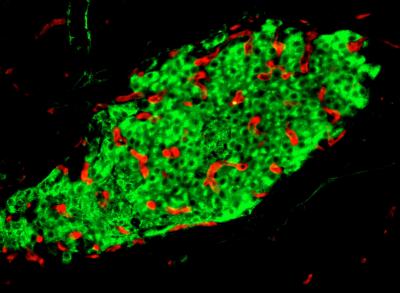
For years researchers have been searching for a way to treat diabetics by reactivating their insulin-producing beta cells, to no avail. Now, they may be one step closer. A protein, whose role in pancreatic development has long been recognized, has been discovered to play an additional and previously unknown regulatory role in the development of cells in the immature endocrine system. These cells ultimately give rise to pancreatic islet cells, which include beta cells. By carefully defining the developmental steps and genetic circuits that lead to mature beta cells, researchers may be able to one day mimic these developmental processes, thereby facilitating beta-cell growth in the lab, and eventually, new therapies. The findings appear in the July 2009 issue of the Journal of Clinical Investigation.
"The protein, Pdx1, is a pivotal molecule in the regulation of beta-cell development and we hope this type of information could help in efforts to generate beta-cell replacements for the treatment of diabetes," says senior author Doris Stoffers, MD, PhD, Associate Professor of Medicine at the University of Pennsylvania School of Medicine. Stoffers is also a member of the Institute for Diabetes, Obesity, and Metabolism at Penn.
Pdx1 is a key regulator of pancreatic development and adult beta-cell function. For example, loss of a single copy of Pdx1 in mice leads to diabetes; loss of two copies leads to a complete failure of the pancreas to form. This new research expands the role of Pdx1 in beta-cell biology in the developing embryo.
Ultimately, Stoffers says, these findings could help researchers intent on developing cell-based therapeutic approaches to diabetes – though such advances are a long way off. Both type 1 and type 2 diabetes are caused by a loss of insulin-producing beta cells. In theory, transplantation of fresh beta cells should halt the disease, yet researchers have not yet been able to generate these cells in the lab at high efficiency, whether from embryonic stem cells or by reprogramming other mature cell types.
"The prevailing view is if we understood how the process occurs normally, we might be able to apply that information to faithfully and efficiently push the cells down the pathway to ultimately generate beta cells that may be used clinically," she says.
The new findings represent a previously unknown role for Pdx1. Endocrine precursor cell development is controlled by a DNA-binding transcription factor called neurogenin-3 (Ngn3). Ngn3, in turn, is regulated by four additional proteins: Sox9, Foxa2, Hnf6, and Hnf1b. In short, this study found that Pdx1 binds directly to the Ngn3 gene to orchestrate gene expression with these proteins.
Specifically, Stoffers was curious about the function of one end of the Pdx1 protein – the C terminus – whose role in beta-cell development was not known – and yet is mutated in certain diseases. Her team, led by MD-PhD candidate Jennifer Oliver-Krasinski, developed mice that lacked the C terminus, essentially with a shortened Pdx1 protein.
The team found that when both copies of the Pdx1 gene were truncated at the C terminus, the pancreas formed, but the mice quickly developed diabetes. When they investigated why, they found that these mice were deficient in all endocrine cells, including beta cells.
"That led us to conclude the defect was at an early cell, or precursor, stage," Stoffers says – specifically, in the formation of Ngn3-expressing endocrine progenitor cells.
Further molecular characterization of these mutant mice led the team to conclude that Pdx1 is a master regulator of the development of endocrine cell precursors. Pdx1 binds directly to the Ngn3 gene, controlling its expression; it does this by forming a molecular complex with the protein Hnf6, which is mediated by the Pdx1 C terminus. Pdx1 also binds directly to and controls the expression of two additional endocrine cell genes, Hnf1b and Foxa2.
"Pdx1 not only directly regulates Ngn3, it also indirectly regulates it by controlling the regulatory network of Sox9, Foxa2, Hnf6, and Hnf1b," she explains.
The most immediate implications of the findings also suggest a molecular mechanism for why those individuals who harbor mutations in Pdx1 get diabetes. If Pdx1 controls Ngn3, and Ngn3 governs endocrine progenitor cell formation, then loss of Pdx1 should result in a loss of endocrine lineages, including beta cells.
That appears to be the case in mice. Now, says Stoffers, the question is: Does this regulatory pathway look and act the same in humans as in mice? "It is likely that the mechanisms are the same, but we would like to directly test that," concludes Stoffers.
Source: University of Pennsylvania School of Medicine
Other sources
- New role discovered for molecule important in development of the pancreasfrom Biology News NetSat, 11 Jul 2009, 1:56:12 UTC
- New Role Discovered For Molecule Important In Development Of The Pancreasfrom Science DailyFri, 10 Jul 2009, 17:21:31 UTC
- New Role Discovered for Molecule Important in Development of Endocrine Systemfrom PhysorgThu, 9 Jul 2009, 20:21:27 UTC