


Visualizing virus replication in three dimensions
Related images
(click to enlarge)
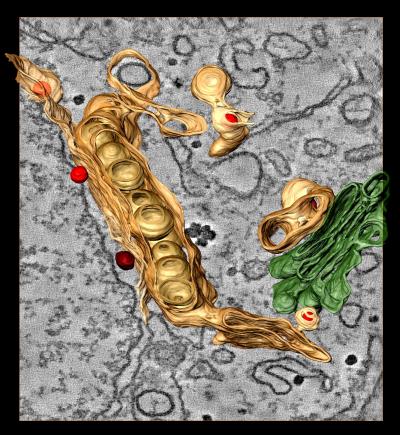
Dengue fever is the most common infectious disease transmitted by mosquitoes – some 100 million people around the world are infected. Researchers at the Hygiene Institute at Heidelberg University Hospital were the first to present a three-dimensional model of the location in the human cell where the virus is reproduced. Their research provides an insight into the exact process of viral replication and serves as a model for other viruses whose replication is still unclear, such as the hepatitis C virus. In addition, it offers new approaches for developing measures to prevent or treat dengue fever. Up to now, neither a vaccine nor a specific antiviral therapy exists. Professor Dr. Ralf Bartenschlager, director of the Department of Molecular Virology at the Heidelberg Hygiene Institute and his team, working in cooperation with colleagues from the European Molecular Biology Laboratory (EMBL) have published their study in the latest issue of the prestigious journal Cell Host & Microbes.
Viruses do not have a metabolism and cannot produce proteins from their genetic material (RNA or DNA) on their own. They can replicate only inside a host cell – but where and how exactly does this take place? The answer to this question is crucial for developing therapy.
Viruses transform human cell membranes for their purposes
Dengue viruses reproduce in what is known as the endoplasmic reticulum, a membrane network interconnected with the nuclear envelope; this is where proteins are synthesized. The dengue virus uses this membrane network and transforms it for its own use.
"We now know that viral RNA is replicated in vesicles in the endoplasmic reticulum and is secreted through tiny pores. We were also able to show that replication of the virus genome and its encapsulation in new virus particles are directly linked," said Professor Bartenschlager. The new virus genomes are secreted through pores into the intracellular space where they are incorporated into pre-stages of viruses and then penetrate the endoplasmic reticulum a second time. There they are enveloped in a membrane that disguises them for the cell so that they can be secreted like normal cellular material. The reproduction cycle can begin again.
Source: University Hospital Heidelberg
Articles on the same topic
- Dengue fever costs billions in health care, lost productivity and absenteeismThu, 7 May 2009, 17:44:17 UTC
Other sources
- Mosquito Parasite May Help Fight Dengue Feverfrom Science DailyThu, 7 May 2009, 23:14:44 UTC
- Dengue fever costs billions in health care, lost productivity and absenteeismfrom Science BlogThu, 7 May 2009, 19:42:19 UTC
- Dengue fever costs billions in health care, lost productivity and absenteeismfrom PhysorgThu, 7 May 2009, 18:07:10 UTC
- Visualizing virus replication in three dimensionsfrom PhysorgThu, 7 May 2009, 17:42:27 UTC