


Why the swamp sparrow is hitting the high notes
Related images
(click to enlarge)
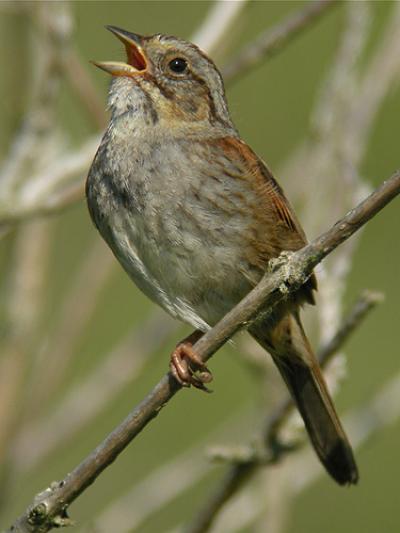
Birdsongs are used extensively as models for animal signaling and human speech, offering a glimpse of how our own communicating abilities developed. A new study by Adrienne DuBois, a graduate student at the University of Miami (UM) College of Arts and Sciences Department of Biology, shows that the Swamp Sparrow has the ability to emit songs that are physically difficult to produce during hostile situations, implying that songbirds use sophisticated vocal performances as signals in aggressive communication. The findings contribute to the current understanding of how animals use signals to communicate.
The study published online in Biology Letters is entitled Swamp Sparrows Modulate Vocal Performance in an Aggressive Context. DuBois investigated whether vocal performance (a measure of how well a male sings songs that are difficult to produce) is used as a signal in aggressive interactions between male songbirds. The study reveals that, when challenged, the male Swamp Sparrow escalates its vocal performance by increasing the frequency range and the speed of its song.
"Vocal performance was thought to be a static characteristic—set once a song is learned," DuBois said. "Our results are the first to show that songbirds can modulate vocal performance, when it is important to do so."
Theoretically, only males with better genes, or that are in better condition, should be able to produce high performance songs. However, the study found that males are able to increase their vocal performance when challenged by a competitor, explained Bill Searcy, Maytag professor of Ornithology in the UM College of Arts and Science and co-author of the study.
"Even in the case of signals whose properties are physically constrained to reflect an individual's abilities, animals exaggerate their signals as much as they can, during critical situations," Searcy said.
The slow trills of the Swamp Sparrows can be heard during spring and summer across the Eastern and Central North American wetlands. This small songbird with a grey face and reddish wings defends his territory and attracts a mate usually by singing from a raised perch in a brushy swamp.
Results from research on birdsong can be extrapolated to other areas of study, including the evolution of communication, and animal cognition, explained Steve Nowicki, Duke University professor, dean of Undergraduate Education and co-author of the study.
"By understanding what animals do in their natural environment, we get a glimpse of what their brains can do," said Nowicki, "In a broader sense, we can make assumptions about the way the animal brain develops to support a complex communication system."
Source: University of Miami
Other sources
- Study shows songbirds react to hostilityfrom UPIMon, 12 Jan 2009, 14:56:32 UTC
- Why the swamp sparrow is hitting the high notesfrom Biology News NetSun, 11 Jan 2009, 20:14:15 UTC
- Why the swamp sparrow is hitting the high notesfrom Biology News NetSat, 10 Jan 2009, 6:42:24 UTC
- Why The Swamp Sparrow Is Hitting The High Notesfrom Science DailyFri, 9 Jan 2009, 18:21:09 UTC
- Why the swamp sparrow is hitting the high notesfrom PhysorgFri, 9 Jan 2009, 17:49:29 UTC