


Clicking knees are antelopes' way of saying 'back off'
Related images
(click to enlarge)
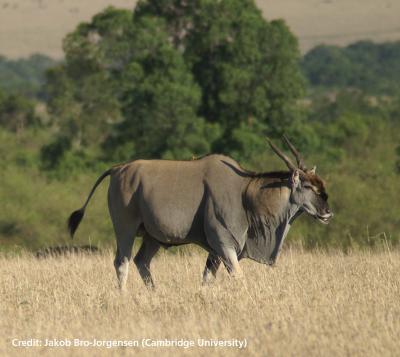
Knee clicking can establish mating rights among antelopes. A study of eland antelopes, published in the open access journal BMC Biology, has uncovered the dominance displays used by males to settle disputes over access to fertile females, without resorting to genuine violence. Jakob Bro-Jørgensen from the Zoological Society of London and Torben Dabelsteen from the University of Copenhagen studied antelopes within a 400km2 area of Kenya. They found that the males (bulls) use a selection of signals to make competitors aware of their fighting ability, based on three different factors, body size, age and aggression. According to Bro-Jørgensen, "Rivals often use signals to broadcast their fighting ability and thereby settle conflicts without incurring the high costs associated with actual fighting".
As well as the knee clicks, which are shown to be a reliable indicator of body size, the researchers found that the size of a bull's dewlap is related to age. The authors said, "Age is a good proxy for fighting experience and may also demonstrate that a bull has 'nothing to lose' and will therefore be a more risk-prone and dangerous adversary". Finally, hair darkness reflects yet another underlying variable, most likely androgen-related aggressiveness. All of these indicators serve the useful purpose of facilitating assessment by a bull's rivals and avoiding wasteful conflict.
The antelopes' knee clicks, which can be heard several hundred metres away, are thought to be produced by a tendon slipping over one of the leg bones and, according to the authors, this can explain why they correlate with body size, "The tendon in this case behaves like a string being plucked, and the frequency of the sound from a string correlates negatively with both its length and diameter. Thus, most importantly, depth of the sound is predicted to increase with skeletal measures".
Source: BioMed Central
Other sources
- Clicking knees are antelopes' way of saying 'back off'from Science BlogSun, 9 Nov 2008, 3:42:22 UTC
- Clicking knees are antelopes' way of saying 'back off'from Biology News NetThu, 6 Nov 2008, 20:14:31 UTC
- Clicking knees are antelopes' way of saying 'back off'from Science BlogThu, 6 Nov 2008, 14:14:15 UTC
- Antelope knee-clicking sets mating rightsfrom UPIWed, 5 Nov 2008, 16:07:29 UTC
- Clicking knees are antelopes' way of saying 'back off'from Biology News NetTue, 4 Nov 2008, 6:28:16 UTC
- Clicking knees are antelopes' way of saying 'back off'from PhysorgTue, 4 Nov 2008, 0:35:09 UTC
- Antelope's sex signal in the kneefrom BBC News: Science & NatureTue, 4 Nov 2008, 0:21:10 UTC