


Building a better bee
Related images
(click to enlarge)
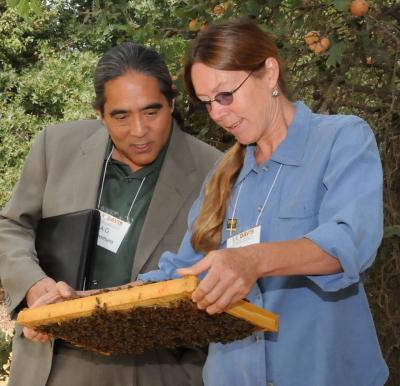
A UC Davis researcher known for her honey bee line "New World Carniolans" has crossed her bees with their Old World counterparts to enhance their positive characteristics. "The bees are very gentle, very hygienic and very productive, and hopefully will confer increased resistance to pests and disease," said UC Davis bee breeder-geneticist Susan Cobey.
The Carniolan honey bee (Apis mellifera carnica) is a subspecies of the Western honey bee. The subspecies, which originated in Slovenia, is the second most popular among California beekeepers, after another Western honey bee subspecies, the Italian honey bee.
UC Cooperative Extension apiculturist Eric Mussen of UC Davis said genetic research of honey bees is critical for the bee industry.
"Although we spend a considerable amount of time trying to find short-term fixes to our honey bee disease and pest control problems, in the long run, the genetic solution of resistant stocks will be a better solution," Mussen said.
Cobey said her research program focuses on identifying, selecting and enhancing honey bee traits that show increasing levels of resistance to pests and diseases. She developed her line of Carniolans, a dark race of honey bees, in the early 1980s by back-crossing bees collected from throughout the United States to create a more pure strain.
"Over time, it has proven very productive, winter hardy, well-tempered and more resistant to pests and disease," she said. "For many years I have wanted to work with pure Carnica. Now I can."
Cobey imported semen from Germany in 2006 and again this year to make additional crosses. She said genetic diversity is critical in maintaining colony fitness and resisting pests and diseases.
The bee species now known as the Western honey bee was initially brought from Europe to America in 1622 and to California in 1853. Mussen and Cobey attribute the bees' decline to multiple factors: diseases, pesticides, parasites, malnutrition, stress, climate change, and colony collapse disorder, in which bees mysteriously abandon their hives.
Cobey collaborates with a team of scientists from Canada, Maryland, Minnesota and Washington states on the bee breeding program. They include viral researcher Michelle Flenniken, the newly selected Häagen-Dazs post-doctoral researcher at UC Davis; reproductive specialists John Pollard and Claire Plante of GeneSafe Technologies, Ltd., Guelph, Canada; apiculturists Steve Sheppard of Washington State University, Pullman, and Marla Spivak of the University of Minnesota, St. Paul; and USDA scientists Jeff Pettis and Judy Chenn of Beltsville, Md.
The scientists obtained permits from the USDA's Animal Plant Health Inspection Service to import semen for a three-year period, 2008 to 2010, from three honey bee subspecies, one from Italy, one from Germany and one from Turkey. To assure that the imported semen carries no diseases, the scientists established a quarantine area in an ecological preserve at WSU. The queens were recently released from the WSU quarantine and are now at UC Davis for evaluation and propagation.
The UC Davis scientist will report on her work at the California State Beekeepers' Association's 119th annual convention, Nov. 11 to 13 in Harrah's, Lake Tahoe, and at the Almond Board Convention in Modesto in early December.
The next step? Cobey and her team will develop protocol for the safe importation of honey bee gametes, eggs and semen. "At present, there is no standard for honey bees, as is common for mammals," she said.
Source: University of California - Davis
Other sources
- Building A Better Beefrom Science DailyThu, 23 Oct 2008, 15:28:16 UTC
- Building a better beefrom Biology News NetThu, 23 Oct 2008, 15:22:03 UTC
- Building a Better Bee: New World and Old World Unitefrom Science BlogThu, 23 Oct 2008, 4:42:13 UTC
- Building a better beefrom Biology News NetWed, 22 Oct 2008, 1:28:48 UTC
- Building a Better Bee: New World and Old World Unitefrom Science BlogWed, 22 Oct 2008, 0:28:05 UTC
- Building Better Beesfrom PhysorgTue, 21 Oct 2008, 21:21:29 UTC