


NIST chemists get scoop on crude 'oil' from pig manure
Related images
(click to enlarge)
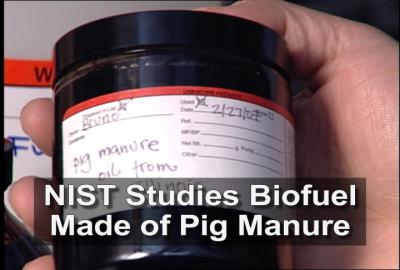
After a close examination of crude oil made from pig manure, chemists at the National Institute of Standards and Technology (NIST) are certain about a number of things. Most obviously, "This stuff smells worse than manure," says NIST chemist Tom Bruno.
But a job's a job, so the NIST team has developed the first detailed chemical analysis revealing what processing is needed to transform pig manure crude oil into fuel for vehicles or heating. Mass production of this type of biofuel could help consume a waste product overflowing at U.S. farms, and possibly enable cutbacks in the nation's petroleum use and imports. But, according to a new NIST paper,* pig manure crude will require a lot of refining.
The ersatz oil used in the NIST analyses was provided by engineer Yuanhui Zhang of the University of Illinois Urbana-Champaign. Zhang developed a system using heat and pressure to transform organic compounds such as manure into oil.
As described in the new paper, Bruno and colleagues determined that the pig manure crude contains at least 83 major compounds, including many components that would need to be removed, such as about 15 percent water by volume, sulfur that otherwise could end up as pollution in vehicle exhaust, and lots of char waste containing heavy metals, including iron, zinc, silver, cobalt, chromium, lanthanum, scandium, tungsten and minute amounts of gold and hafnium. Whatever the pigs eat, from dirt to nutritional supplements, ends up in the oil.
While the thick black liquid may look like its petroleum-based counterparts, the NIST study shows that looks can be deceiving. "The fact that pig manure crude oil contains a lot of water is unfavorable. They would need to get the water out," Bruno says.
The measurements were made with a new NIST test method and apparatus, the advanced distillation curve, which provides highly detailed and accurate data on the makeup and performance of complex fluids. A distillation curve charts the percentage of the total mixture that evaporates as a sample is slowly heated. Because the different components of a complex mixture typically have different boiling points, a distillation curve gives a good measure of the relative amount of each component in the mixture. NIST chemists enhanced the traditional technique by improving precision and control of temperature measurements and adding the capability to analyze the chemical composition of each boiling fraction using a variety of advanced methods.
NIST researchers analyzed the graphite-like char remaining after the distillation by bombarding it with neutrons, a non-destructive way of identifying the types and amounts of elements present. Two complementary neutron methods detected the heavy metals listed above.
Bruno and colleagues currently spend much of their time analyzing military jet fuels and are not planning a major foray into pig manure. But Bruno concedes that the effort may have a payoff. "Who knows, it might help decrease the nuisance of manure piles."
Source: National Institute of Standards and Technology (NIST)
Other sources
- Crude 'oil' from pig manurefrom Science BlogThu, 12 Jun 2008, 16:07:12 UTC
- Chemists Get Scoop On Crude 'Oil' From Pig Manurefrom Science DailyThu, 12 Jun 2008, 14:35:27 UTC
- Chemists Get Scoop on Crude 'Oil' from Pig Manurefrom Newswise - ScinewsWed, 11 Jun 2008, 21:07:52 UTC
- Chemists Get Scoop on Crude ‘Oil` from Pig Manurefrom PhysorgWed, 11 Jun 2008, 18:07:15 UTC