


Toad research could leapfrog to new muscle model
Related images
(click to enlarge)
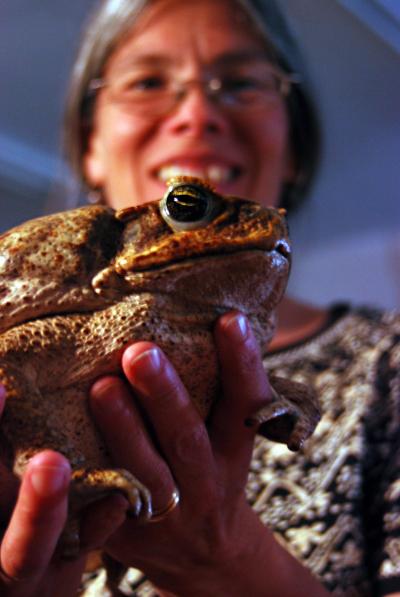
A toad sits at a pond's edge eyeing a cricket on a blade of grass. In the blink of an eye, the toad snares the insect with its tongue. This deceptively simple, remarkably fast feeding action offers a new look at how muscles work. This fresh perspective could lead to designing more efficient electric motors, better prostheses and new medical treatments for neuromuscular diseases like Parkinson's.
Science has long held that muscles behave largely like motors. Northern Arizona University researcher Kiisa Nishikawa suggests that muscle acts more like a spring.
"Existing theories don't explain how muscles shorten rapidly," Nishikawa said. "Muscles can only shorten to do work; they can't do work by lengthening." A spring also can only do work by shortening.
By example, Nishikawa explains that the jaw muscles in toads and chameleons shorten in the lower jaw, and the opening of the jaws causes the tongue to stretch by its own momentum.
"When a toad or chameleon captures prey with its tongue, it exerts force over a distance. Figuring out how they do it has immense application to any device that actually moves."
A toad's jaw muscles can produce forces greater than 700 times the animal's weight. "The best electric motor achieves about one-third of that force-to-weight ratio," Nishikawa noted.
Muscles also function as self-stabilizing springs.
"They have built-in self-correcting mechanisms. Before the brain can even react, muscles are changing their elasticity adaptively," she said. Think of walking down a flight of steps and missing a step. Leg muscles instantly become less stiff to afford better shock absorption. "It's an intrinsic property of muscle," Nishikawa said.
Tom Sugar and his colleagues Arizona State University have been inspired by biology in designing a robotic tendon. After meeting with Nishikawa about her work, Sugar said, "We were amazed at the speed, energy storage and power of muscle. We learned how a frog tongue will store energy and release it in a powerful burst."
At ASU's Human Machine Integration Laboratory, Sugar and his team are building "SPARKy" (Spring Ankle with Regenerative Kinetics) that mimics biology by storing and releasing energy during the ankle gait cycle.
"Energy is stored as the leg and body rolls over the ankle, and then this energy is released in a powerful burst to propel the user forward. By mimicking biology, we are able to build a very lightweight and functional device," Sugar said.
"Putting motors and springs together in a smart way is something nature hit on about 600 million years ago (with the earliest vertebrates)," Nishikawa said.
It's a notion that captured the interest of Discovery Channel Canada, which spent a day at NAU and a day at ASU taping for a segment of its Daily Planet show that will air in the fall.
The NAU researcher wants to know more about how the brain controls movement. About decade ago Nishikawa realized that how the brain and body work together to produce coordinated movement means understanding what muscles contribute to the whole process.
"Understanding what the neurological part is and what the muscular part is can help establish cause and effect," she said.
Identifying these mechanisms at the molecular level might aid medical research in developing better treatments for sufferers of Parkinson's, whose low force output results in stiff movements.
Nishikawa's studies of the neuromuscular basis for extremely rapid movements in animals, such as the toad snaring prey with its tongue, could leapfrog to a new model of muscle function, changing the standard representation of muscle as a motor.
Source: Northern Arizona University
Other sources
- Toad Research Could Leapfrog To New Muscle Modelfrom Science DailyTue, 3 Jun 2008, 3:14:39 UTC
- Toad research could leapfrog to new muscle modelfrom Biology News NetTue, 3 Jun 2008, 2:07:05 UTC
- Toad Research Could Leapfrog to New Muscle Modelfrom Newswise - ScinewsMon, 2 Jun 2008, 20:28:29 UTC
- Toad research could leapfrog to new muscle modelfrom PhysorgMon, 2 Jun 2008, 18:56:17 UTC