


Gene mutations in mice mimic human-like sleep disorder, UT Southwestern researchers find
Related images
(click to enlarge)
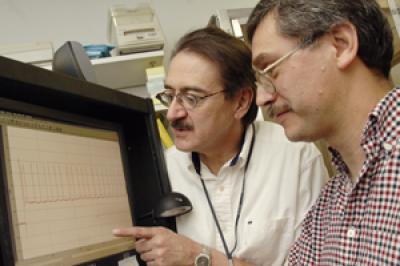
Mutations in two genes that control electrical excitability in a portion of the brain involved in sleep create a human-like insomnia disorder in mice, UT Southwestern Medical Center researchers have found. The findings may help scientists better understand the disorder and provide an animal model for developing treatments. “This is one of the most dramatic sleep-disturbance mutations,” said Dr. Rolf Joho, associate professor of neuroscience and senior author of the paper, which appears online today and in the May 21 issue of The Journal of Neuroscience. “The mice sleep half as much as normal mice.”
The mutant mice appeared to have a condition similar to a human disorder called sleep maintenance insomnia, in which sufferers can get to sleep, but don’t remain at rest for long.
“We’re trying to look at where in the brain this originates,” Dr. Joho said. “The same mechanism could be involved in many neurophysiological disorders.”
The researchers focused on two genes that encode molecules known as ion channels. An ion channel is a pore that spans a cell’s membrane, opening and closing to allow charged atoms, or ions, to cross the membrane. The coordinated opening and closing of various ion channels allows nerve cells to carry electrical signals.
In the current study, the researchers examined two channels that allow potassium ions to cross the cell membrane. The researchers genetically engineered mice to have defects in the ion channels Kv3.1 and Kv3.3, which normally open and close much faster than other potassium channels.
These channels are common in a portion of the brain called the thalamic reticular nucleus, which is thought to act as a “pacemaker” during sleep, controlling slow-wave sleep – the deep, restful sleep that occurs without dreams.
The mutant mice slept only 50 percent to 60 percent as much as normal mice. Measurements of their brain waves showed that they entered slow-wave sleep, but only for short periods before waking again.
The mice did not readily get restful sleep even after sleep deprivation, the researchers found.
In future studies, the researchers hope to focus on the Kv3.1 mutation alone, which they believe, based on previous studies might be the primary factor in the sleep disturbances, while Kv3.3 mutations might affect muscle coordination.
The researchers also plan to investigate ways to restore function of Kv3.1 with potential drugs. So far, there are no medications that affect this ion channel.
Source: UT Southwestern Medical Center
Other sources
- Gene Mutations In Mice Mimic Human-like Sleep Disorderfrom Science DailyThu, 22 May 2008, 20:14:16 UTC
- Gene mutations in mice mimic human-like sleep disorder, researchers findfrom PhysorgTue, 20 May 2008, 21:56:23 UTC
- Gene Mutations in Mice Mimic Human-like Sleep Disorderfrom Newswise - ScinewsTue, 20 May 2008, 21:35:22 UTC