


RFID testbed measures multiple tags at once and rapidly assesses new antenna designs
Related images
(click to enlarge)
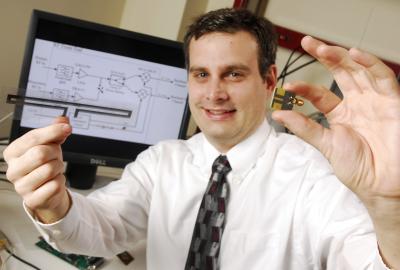
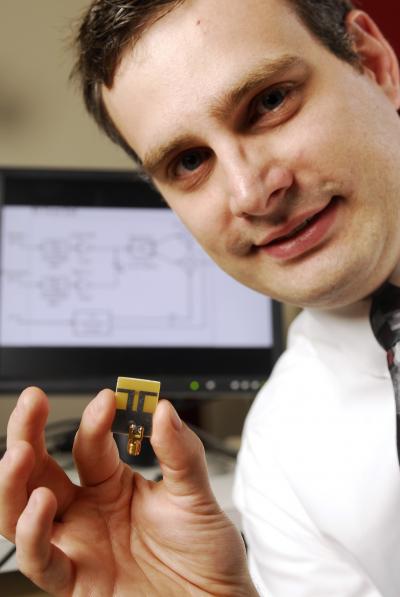
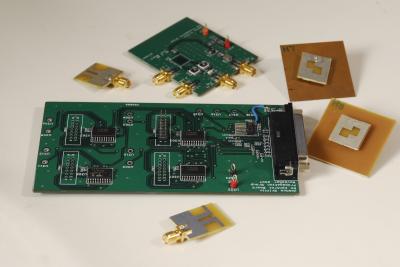
Researchers have designed a system capable of simultaneously measuring hundreds of radio frequency identification (RFID) tags and rapidly testing new RFID tag prototypes. “This testbed allows us to measure the signal strength of tags hidden behind other tags and to rapidly test unique antenna configurations and multiple antennas without actually constructing new tags for each experiment,” said Gregory Durgin, an assistant professor in the Georgia Institute of Technology’s School of Electrical and Computer Engineering.
The research, funded by the National Science Foundation and conducted with former graduate student Anil Rohatgi and current graduate student Joshua Griffin, was presented in April at the IEEE International Conference on RFID.
RFID tags are used for applications that include inventory management, package tracking, toll collection, passport identification and airport luggage security. Passive tags include an integrated circuit for storing and processing information, and an antenna that responds to radio waves transmitted from an RFID reader. The tag absorbs some of the radio frequency energy from the reader signal and reflects it back as a return signal delivering information from the tag’s memory, a technique called backscatter.
If several RFID tags are in the vicinity of a reader, the reader usually communicates with the tag transmitting the most powerful signal first and then puts it to ‘‘sleep’’ to prevent it from transmitting repeatedly. Then the reader moves to the next most powerful signal, and so on. This process can be very time-consuming.
“We designed a really inexpensive, simple anti-collision system that transmits multiple unique signals back to us simultaneously without this complicated back and forth process,” said Durgin.
The system includes three parts – a transmitter, receiver and emulator. The emulator simulates the activity of an integrated circuit. The transmitter sends a radio signal to the antenna. By attaching the emulator to an antenna, a unique spread spectrum signal is transmitted to the receiver.
Each antenna signal can then be separated from the others, allowing his team to simultaneously measure the signals from multiple tags. Their experiments have shown they can measure the power strength and phase of up to 256 antennas in the field of view, which is an area in front of the reader of approximately 20 feet by 20 feet.
“To test new signaling schemes and frequencies, we just have to change the emulator’s signal – we don’t have to fabricate a new chip that could cost $100,000 in a silicon foundry,” he added. “We can also evaluate multiple custom antennas in numerous configurations in realistic tag environments for only a fraction of the time and cost of previous methods.”
Testing multiple configurations is important because RFID readability and antenna power strength can be affected by the relative position and orientation of the tag antenna and the reader.
The researchers designed the testbed for measurements at 915 megahertz, a common ultra-high frequency for backscatter RFID applications. They are currently expanding the system to test antennas at higher frequencies – up to 5.7 gigahertz.
“At higher frequencies, even though the tag is physically stationary, you are electromagnetically lifting the antenna signal off the object and it starts to work better,” he said. “Plus, at higher frequencies, smaller antennas can be constructed, which means more antennas can be placed on a tag to produce more energy for communications.”
The tags usually require a reader to be within a foot of the chip, but operating at higher frequencies could greatly improve the range and reliability of the RFID tags, according to Durgin.
“This testbed is just the beginning of our ability to characterize the performance of different RFID tag antennas in a real channel and push these technologies to higher frequencies, longer read ranges and overall higher reliability,” he added.
Source: Georgia Institute of Technology Research News
Other sources
- RFID Testbed Measures Multiple Tags At Once And Rapidly Assesses New Antenna Designsfrom Science DailyFri, 9 May 2008, 0:21:17 UTC
- Improved RFID system is createdfrom UPITue, 6 May 2008, 15:42:10 UTC
- RFID testbed measures multiple tags at once and rapidly assesses new antenna designsfrom PhysorgMon, 5 May 2008, 21:21:30 UTC
- RFID Testbed Rapidly Assesses New Antenna Designsfrom Newswise - ScinewsMon, 5 May 2008, 21:21:19 UTC