


Chandra images torrent of star formation
Related images
(click to enlarge)
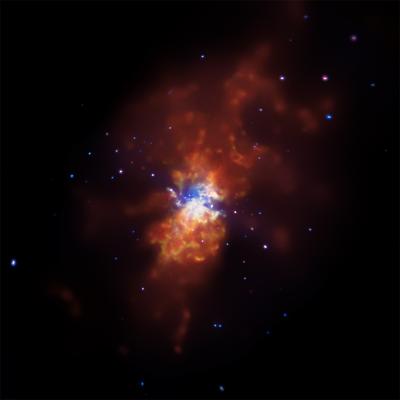
A new Chandra X-ray Observatory image of Messier 82, or M82, shows the result of star formation on overdrive. At a distance of only 12 million light years, M82 provides a unique cosmic laboratory for studying conditions similar to those that existed billions of years ago when stars were forming at a furious rate in most galaxies. M82 is a so-called starburst galaxy, where stars are forming at rates that are tens or even hundreds of times higher than in a normal galaxy. The burst of star birth may be caused by a close encounter or collision with another galaxy, which sends shock waves rushing through the galaxy. In the case of M82, astronomers think that a brush with its neighboring galaxy M81 millions of years ago set off this torrent of star formation.
M82 is seen nearly edge-on with its disk crossing from about 10 o'clock to about 4 o'clock in this image from Chandra (where low, medium, and high-energy X-rays are colored red, green, and blue respectively.) Among the 104 point-like X-ray sources in the image, eight so far have been observed to be very bright in X-rays and undergo clear changes in brightness over periods of weeks and years. This means they are excellent candidates to be black holes pulling material from companion stars that are much more massive than the Sun. Only a handful of such binary systems are known in the Local Group of galaxies containing the Milky Way and M31.
Chandra observations are also important in understanding the consequences of the rapid rate at which supernovas explode in starburst galaxies. When the shock waves from supernovas rumble through the galaxy, they push on giant clouds of gas and dust, causing them to collapse and form massive stars. These stars, in turn, use up their fuel quickly and explode as supernovas. This chain reaction of supernovas produces expanding bubbles of multimillion-degree gas that extend for tens of thousands of light years above from the galaxy's disk. The large red areas to the upper right and lower left of the image are examples of such bubbles.
Source: Chandra X-ray Center
Other sources
- Chandra Images Torrent of Star Formationfrom Newswise - ScinewsThu, 13 Jan 2011, 22:00:49 UTC
- Chandra images torrent of star formationfrom Science BlogThu, 13 Jan 2011, 22:00:24 UTC
- Chandra images torrent of star formationfrom PhysorgThu, 13 Jan 2011, 21:31:29 UTC