


Different sources, same result
Related images
(click to enlarge)
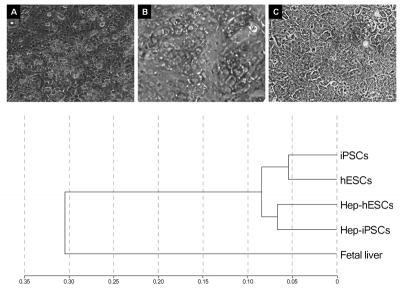
Numerous patients suffering from chronic liver diseases are currently receiving inadequate treatment due to the lack of organs donated for transplantation. However, hepatocytes derived from induced pluripotent stem cells (iPSCs) could offer an alternative for the future. Scientists from the Max Planck Institute for Molecular Genetics in Berlin compared hepatocytes from embryonic stem cells with hepatocytes from iPS cells and found that their gene expression is very similar. Nevertheless, in comparison to "real" hepatocytes, just under half of the genes exhibited a different gene expression. Therefore, the gene expression of hepatocytes derived from iPS cells still requires adaptation before the cells could be used in the treatment of liver diseases. (Stem Cells and Development, December 20, 2010) Induced pluripotent stem cells can be derived from different cell types and have the same genetic background as their progenitors. Hepatocytes derived from iPSCs therefore constitute an ideal point of departure for future regenerative therapy, as immune rejection between donor and host cells can be avoided.
In their study, the Max Planck scientists compared hepatocyte-like cells derived from iPS cells and embryonic stem cells with "real" hepatocytes in early and later stages of development. Justyna Jozefczuk from the Max Planck Institute for Molecular Genetics explains: "It is the only way to determine actual differences between the cell types, and any flaws still present in the 'synthetic' hepatocytes". The scientists were able to show that the gene expression of hepatocytes based on embryonic stem cells and iPSCs is about 80 per cent similar. However, compared to isolated cells from the foetal human liver, the gene expression match is only 53 per cent.
Hepatocyte-like cells from iPSCs and embryonic stem cells activate many of the typical liver proteins, e.g., albumin, alpha-fetoprotein and cytokeratin 18. Moreover, the "synthetic" hepatocytes can store glycogen and produce urea, just like the "real" hepatocytes. In addition, they are able to absorb and break down foreign molecules. In contrast, the genes around the enzyme group cytochrome P450 in the iPSCs and in real hepatocytes display different expression levels. These enzymes metabolise, among other things, drugs and foreign substances. "This knowledge not only helps us better understand the causes of liver diseases; it also allows us to develop more efficient, patient-specific drugs", says James Adjaye from the Max Planck Institute for Molecular Genetics.
Source: Max-Planck-Gesellschaft
Other sources
- Different sources, same resultfrom Science BlogWed, 5 Jan 2011, 16:36:52 UTC
- Induced pluripotent stem cells from foetal skin cells, embryonic stem cells display comparable potential for derivationfrom PhysorgTue, 4 Jan 2011, 21:32:25 UTC