


Quantum move toward next generation computing
Related images
(click to enlarge)
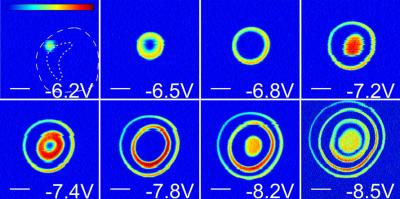
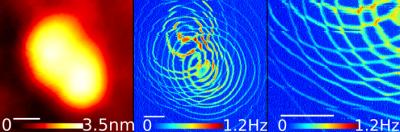
This release is available in French. Physicists at McGill University have developed a system for measuring the energy involved in adding electrons to semi-conductor nanocrystals, also known as quantum dots – a technology that may revolutionize computing and other areas of science. Dr. Peter Grütter, McGill's Associate Dean of Research and Graduate Education, Faculty of Science, explains that his research team has developed a cantilever force sensor that enables individual electrons to be removed and added to a quantum dot and the energy involved in the operation to be measured.
Being able to measure the energy at such infinitesimal levels is an important step in being able to develop an eventual replacement for the silicon chip in computers – the next generation of computing. Computers currently work with processors that contain transistors that are either in an on or off position – conductors and semi-conductors – while quantum computing would allow processors to work with multiple states, vastly increasing their speed while reducing their size even more.
Although popularly used to connote something very large, the word "quantum" itself actually means the smallest amount by which certain physical quantities can change. Knowledge of these energy levels enables scientists to understand and predict the electronic properties of the nanoscale systems they are developing.
"We are determining optical and electronic transport properties," Grütter said. "This is essential for the development of components that might replace silicon chips in current computers."
The electronic principles of nanosystems also determine their chemical properties, so the team's research is relevant to making chemical processes "greener" and more energy efficient. For example, this technology could be applied to lighting systems, by using nanoparticles to improving their energy efficiency. "We expect this method to have many important applications in fundamental as well as applied research," said Lynda Cockins of McGill's Department of Physics.
The principle of the cantilever sensors sounds relatively simple. "The cantilever is about 0.5 mm in size (about the thickness of a thumbnail) and is essentially a simple driven, damped harmonic oscillator, mathematically equivalent to a child's swing being pushed," Grütter explained. "The signal we measure is the damping of the cantilever, the equivalent to how hard I have to push the kid on the swing so that she maintains a constant height, or what I would call the 'oscillation amplitude.' "
Dr. Aashish Clerk, Yoichi Miyahara, and Steven D. Bennett of McGill's Dept. of Physics, and scientists at the Institute for Microstructural Sciences of the National Research Council of Canada contributed to this research, which was published online late yesterday afternoon in the Proceedings of the National Academy of Sciences. The research received funding from the Natural Sciences and Engineering Research Council of Canada, le Fonds Québécois de le Recherche sur la Nature et les Technologies, the Carl Reinhardt Fellowship, and the Canadian Institute for Advanced Research.
Source: McGill University
Other sources
- Quantum move toward next generation computingfrom Science DailyWed, 12 May 2010, 12:20:37 UTC
- Quantum move toward next generation computingfrom PhysorgTue, 11 May 2010, 17:21:13 UTC
- Quantum Move Toward Next Generation Computingfrom Newswise - ScinewsTue, 11 May 2010, 15:20:41 UTC