


Supernova explosions stay in shape
Related images
(click to enlarge)
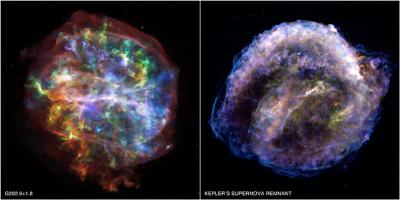
At a very early age, children learn how to classify objects according to their shape. Now, new research suggests studying the shape of the aftermath of supernovas may allow astronomers to do the same. A new study of images from NASA's Chandra X-ray Observatory on supernova remnants - the debris from exploded stars - shows that the symmetry of the remnants, or lack thereof, reveals how the star exploded. This is an important discovery because it shows that the remnants retain information about how the star exploded even though hundreds or thousands of years have passed.
"It's almost like the supernova remnants have a 'memory' of the original explosion," said Laura Lopez of the University of California at Santa Cruz, who led the study. "This is the first time anyone has systematically compared the shape of these remnants in X-rays in this way."
Astronomers sort supernovas into several categories, or "types", based on properties observed days after the explosion and which reflect very different physical mechanisms that cause stars to explode. But, since observed remnants of supernovas are leftover from explosions that occurred long ago, other methods are needed to accurately classify the original supernovas.
Lopez and colleagues focused on the relatively young supernova remnants that exhibited strong X-ray emission from silicon ejected by the explosion so as to rule out the effects of interstellar matter surrounding the explosion. Their analysis showed that the X-ray images of the ejecta can be used to identify the way the star exploded. The team studied 17 supernova remnants both in the Milky Way galaxy and a neighboring galaxy, the Large Magellanic Cloud.
For each of these remnants there is independent information about the type of supernova involved, based not on the shape of the remnant but, for example, on the elements observed in it. The researchers found that one type of supernova explosion - the so-called Type Ia - left behind relatively symmetric, circular remnants. This type of supernova is thought to be caused by a thermonuclear explosion of a white dwarf, and is often used by astronomers as "standard candles" for measuring cosmic distances.
On the other hand, the remnants tied to the "core-collapse" supernova explosions were distinctly more asymmetric. This type of supernova occurs when a very massive, young star collapses onto itself and then explodes.
"If we can link supernova remnants with the type of explosion", said co-author Enrico Ramirez-Ruiz, also of University of California, Santa Cruz, "then we can use that information in theoretical models to really help us nail down the details of how the supernovas went off."
Models of core-collapse supernovas must include a way to reproduce the asymmetries measured in this work and models of Type Ia supernovas must produce the symmetric, circular remnants that have been observed.
Out of the 17 supernova remnants sampled, ten were classified as the core-collapse variety, while the remaining seven of them were classified as Type Ia. One of these, a remnant known as SNR 0548-70.4, was a bit of an "oddball". This one was considered a Type Ia based on its chemical abundances, but Lopez finds it has the asymmetry of a core-collapse remnant.
"We do have one mysterious object, but we think that is probably a Type Ia with an unusual orientation to our line of sight," said Lopez. "But we'll definitely be looking at that one again."
While the supernova remnants in the Lopez sample were taken from the Milky Way and its close neighbor, it is possible this technique could be extended to remnants at even greater distances. For example, large, bright supernova remnants in the galaxy M33 could be included in future studies to determine the types of supernova that generated them.
Source: Chandra X-ray Center
Other sources
- Supernova Explosions Stay in Shapefrom Newswise - ScinewsThu, 17 Dec 2009, 19:56:39 UTC
- Supernova explosions stay in shapefrom PhysorgThu, 17 Dec 2009, 15:57:08 UTC
- Supernova explosions stay in shapefrom Science BlogThu, 17 Dec 2009, 15:56:58 UTC