


TacSat-4 spacecraft complete and awaiting launch
Related images
(click to enlarge)

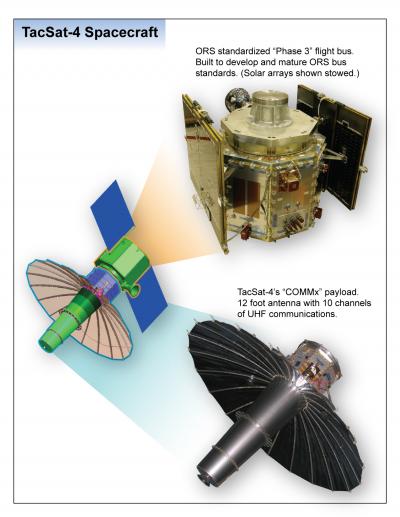
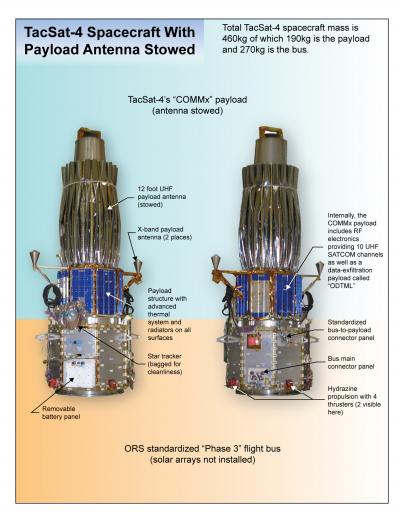
Naval Research Laboratory (NRL) engineers have completed all environmental and performance testing on the TacSat-4 COMMx payload. This completes the entire TacSat-4 spacecraft as the spacecraft bus was completed in May 2008. The launch date was fall 2009, however it was moved to August 2010 because of Minotaur-IV technical issues and changing DoD mission priorities. TacSat-4 is a Navy led joint mission to augment current satellite communications (SATCOM) capabilities and to advance Operationally Responsive Space systems. The TacSat-4 mission was selected by a joint process cumulating in a flag and general officer vote by Army, Navy, Air Force, Marines, and US Strategic Command. TacSat-4 provides ten Ultra High Frequency (UHF) channels, which can be used for any combination of communications, data ex-filtration, or Blue Force Tracking (BFT). TacSat-4's unique orbit augments geosynchronous SATCOM by providing near global, but not continuous, coverage including the high latitudes. TacSat-4 improves on current SATCOM by providing communications-on-the-move for existing radios without requiring antenna pointing. TacSat-4 provides flexible up and down channel assignments, which increases the ability to operate in some interfered environments. The Virtual Mission Operations Center tasking system coupled with the orbit allows dynamic reallocation, within 24 hours during normal operations, to different theaters worldwide enabling rapid SATCOM augmentation when unexpected operations or natural events occur.
NRL is the program manager with the Office of Naval Research funding the payload, management, and first year of operations. The Office of the Secretary of Defense-Office for Technology/Director of Defense Research and Engineering funded the standardized spacecraft bus. The Operationally Responsive Space (ORS) Office and Air Force's Space and Missile Systems Center (SMC) are providing the launch on a Minotaur-IV from Kodiak, Alaska. NRL's Blossom Point Ground Station will perform operations, in coordination with Naval Network Warfare Command and the Global and Regional SATCOM Centers.
The spacecraft bus was built by NRL and Johns Hopkins University Applied Physics Laboratory (APL) to mature ORS bus standards developed by an Integrated (government and industry) System Engineering Team, the "ISET Team," with active representation from AeroAstro, Air Force Research Laboratory, John Hopkins Laboratory APL, ATK Space, Ball, Boeing, Design Net Engineering, General Dynamics AIS, Microcosm, Microsat Systems Inc, Massachusetts Institute of Technology Lincoln Laboratory, Orbital Sciences, NRL, SMC, Space System Loral, and Raytheon.
The TacSat-4 spacecraft, both the COMMx payload and bus, is now in storage awaiting the launch date.
Source: Naval Research Laboratory
Other sources
- TacSat-4 spacecraft ready for launchfrom UPIWed, 2 Dec 2009, 16:28:12 UTC
- TacSat-4 spacecraft complete and awaiting launchfrom Science BlogTue, 1 Dec 2009, 23:07:14 UTC
- TacSat-4 spacecraft complete and awaiting launchfrom PhysorgTue, 1 Dec 2009, 20:21:33 UTC