


How the Moon produces its own water
Related images
(click to enlarge)
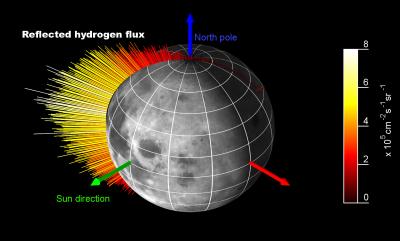
The Moon is a big sponge that absorbs electrically charged particles given out by the Sun. These particles interact with the oxygen present in some dust grains on the lunar surface, producing water. This discovery, made by the ESA-ISRO instrument SARA onboard the Indian Chandrayaan-1 lunar orbiter, confirms how water is likely being created on the lunar surface. It also gives scientists an ingenious new way to take images of the Moon and any other airless body in the Solar System.
The lunar surface is a loose collection of irregular dust grains, known as regolith. Incoming particles should be trapped in the spaces between the grains and absorbed. When this happens to protons they are expected to interact with the oxygen in the lunar regolith to produce hydroxyl and water. The signature for these molecules was recently found and reported by Chandrayaan-1's Moon Mineralogy Mapper (M3) instrument team.
The SARA results confirm that solar hydrogen nuclei are indeed being absorbed by the lunar regolith but also highlight a mystery: not every proton is absorbed. One out of every five rebounds into space. In the process, the proton joins with an electron to become an atom of hydrogen. "We didn't expect to see this at all," says Stas Barabash, Swedish Institute of Space Physics, who is the European Principal Investigator for the Sub-keV Atom Reflecting Analyzer (SARA) instrument, which made the discovery.
Although Barabash and his colleagues do not know what is causing the reflections, the discovery paves the way for a new type of image to be made. The hydrogen shoots off with speeds of around 200 km/s and escapes without being deflected by the Moon's weak gravity. Hydrogen is also electrically neutral, and is not diverted by the magnetic fields in space. So the atoms fly in straight lines, just like photons of light. In principle, each atom can be traced back to its origin and an image of the surface can be made. The areas that emit most hydrogen will show up the brightest.
Whilst the Moon does not generate a global magnetic field, some lunar rocks are magnetised. Barabash and his team are currently making images, to look for such 'magnetic anomalies' in lunar rocks. These generate magnetic bubbles that deflect incoming protons away into surrounding regions making magnetic rocks appear dark in a hydrogen image.
The incoming protons are part of the solar wind, a constant stream of particles given off by the Sun. They collide with every celestial object in the Solar System but are usually stopped by the body's atmosphere. On bodies without such a natural shield, for example asteroids or the planet Mercury, the solar wind reaches the ground. The SARA team expects that these objects too will reflect many of the incoming protons back into space as hydrogen atoms.
This knowledge provides timely advice for the scientists and engineers who are readying ESA's BepiColombo mission to Mercury. The spacecraft will be carrying two similar instruments to SARA and may find that the inner-most planet is reflecting more hydrogen than the Moon because the solar wind is more concentrated closer to the Sun.
Source: European Space Agency
Other sources
- "Rejected" Protons Offer a New View of the Moonfrom National Geographic15 years ago
- How The Moon Produces Its Own Waterfrom Science Daily15 years ago
- How the Moon produces its own waterfrom Science Blog15 years ago
- How the Moon produces its own waterfrom Physorg15 years ago
- How the Moon produces its own waterfrom European Space Agency15 years ago

