


Putting the squeeze on sperm DNA
Related images
(click to enlarge)
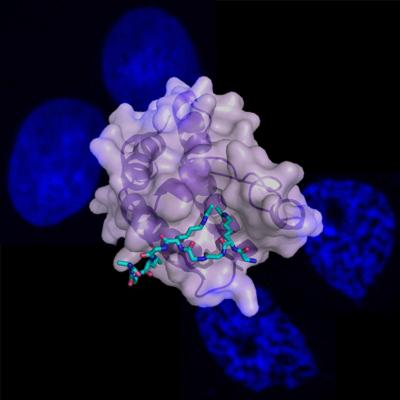
In the quest for speed, olympic swimmers shave themselves or squeeze into high-tech super-suits. In the body, sperm are the only cells that swim and, as speed is crucial to fertility, have developed their own ways to become exceptionally streamlined. Scientists at the European Molecular Biology Laboratory (EMBL) in Heidelberg and Grenoble, the Institut de Biologie Structurale (IBS) and the Institut Albert Bonniot, both also in Grenoble, have been studying the secrets of speedy sperm. Their work, published today in Nature, shows how a protein only found in developing sperm cells, Brdt, directs tight re-packaging of sperm DNA. Because it is such a long and unwieldy molecule, our DNA is packaged for convenience into a complex structure called chromatin: long DNA strands are wound around proteins called histones. In sperm, however, this package has become even more compact, reducing the size of the sperm head and making it more hydrodynamic.
The nature of chromatin – how open or compact it is – is intricately regulated. Histones are marked with different chemical tags, often several per histone, that act as a code to direct changes in chromatin structure. Different proteins bind to the tags, the combination of which deciphers the code.
Until now, scientists thought that these proteins bind using one or more modular 'domains', with each domain docking to just one tag. However, this new study reports the discovery of an extra level of sophistication. The researchers studied histone binding of a protein called Brdt, finding that it binds most strongly to a histone with two of a particular tag (in this case, acetyl groups) – and, contrary to expectations, uses just one protein domain to do so. "We were very surprised," explains Christoph Müller of EMBL. "We looked at the structure and saw that the domain forms a pocket, binding both tags at once."
"In sperm, just before the DNA starts to hypercompact, these tags are added throughout the chromatin in a huge wave," explains Saadi Khochbin of the Institut Albert Bonniot. "If Brdt is absent, the extra compaction doesn't take place, and the sperm head would be less streamlined. Male mice lacking Brdt are infertile."
So is the special way that Brdt binds to histone tags important for its unique compacting ability? "We're not sure, but we can speculate," says Christoph Müller. "One idea is that histones acquire tags sequentially, and only compact when fully tagged. Brdt binds to the last two tags in this sequence, making Brdt-binding the very last step in the process – the final signal for hypercompaction to begin."
"We re-examined the structures of other chromatin-associate proteins and saw that this tag-binding mechanism is likely to be used by them, too, furthering our understanding of how the histone code is read," adds Carlo Petosa of the IBS.
The researchers believe their work will shed light on potential problems in sperm development and are now looking at the role this protein plays in human male infertility.
Source: European Molecular Biology Laboratory
Other sources
- Putting The Squeeze On Sperm DNA: Streamlined Sperm Offer New Way To Read Histone Codefrom Science DailyThu, 1 Oct 2009, 15:28:23 UTC
- Putting the squeeze on sperm DNAfrom Science BlogWed, 30 Sep 2009, 18:21:18 UTC
- Putting the squeeze on sperm DNAfrom PhysorgWed, 30 Sep 2009, 17:56:12 UTC