


ORMatE returns to NRL after nearly 2 years in Earth orbit
Related images
(click to enlarge)
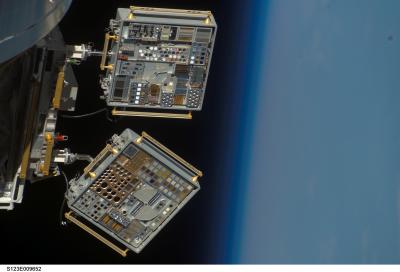
Completing an 18-month mission orbiting the Earth more than 6,000 times on-orbit the International Space Station (ISS), the Optical Reflector Material Experiment (ORMatE-1) returns to Washington, D.C., to NRL's Electronics Science and Technology Division to begin experiment testing and analysis. Retrieved September 2009 by the crew of NASA's Space Shuttle Endeavour, ORMatE-1 is a passive study of optically reflective materials with a focus on silicon carbide (SiC) for use as a lightweight mirror substrate. Various types of SiC ceramics, as well as various coating materials and cladding deposition technologies are also tested in the experiment.
"Lightweight, high precision mirrors are critical for enhanced optical systems and advanced communication systems currently being designed and tested," said Robert Walters, Ph.D., head of NRL's Solid State Devices Branch. "The effects of different optical polishing methods are investigated to determine if the different processes result in varying resistance to radiation exposure for future space-based applications."
ORMatE-1 provides a platform to expose new materials to the harsh environment of space and to generate on-orbit performance data to support space qualification of specific materials. The experiments are housed within the Passive Experiment Container (PEC), a roughly two-foot by two-foot metal box, and affixed to the ISS. After an exposed period of one to two years, the PEC is closed and recovered by an astronaut for return to Earth for post-flight evaluation.
In addition to SiC material testing, NRL scientists will conduct post-flight analysis of other advanced glass substrate materials including ultra-low expansion (ULE) and corrugated borosilicate, multiple coating and traditional substrate combinations and a novel mirror design consisting of a composite sandwich structure of molded borosilicate used to evaluate structural integrity and optical performance. ORMatE-1 will help quantify effects on optical and mechanical properties as a result of radiation, micrometeor pitting and compaction, which can change the radius curvature of components. Research will also assist in determining the effects of degassing of dense and porous materials as a result of going from ambient to vacuum conditions, ultra-violet (UV) and atomic oxygen exposure.
ORMatE-1 is conducted as a scientific research partnership with The Aerospace Corporation, Naval Research Laboratory and the Air Force Research Laboratory Materials Directorate (AFRL/ML) and is part of NASA's Materials on the International Space Station Experiment (MISSE), a Langley Research Center (LaRC) program designed to provide rapid access to space for materials and device exposure tests via the ISS.
Source: Naval Research Laboratory
Other sources
- ORMatE returns to NRL after nearly 2 years in Earth orbitfrom PhysorgWed, 30 Sep 2009, 16:42:13 UTC
- ORMatE returns to NRL after nearly 2 years in Earth orbitfrom Science BlogWed, 30 Sep 2009, 14:07:40 UTC