


A step toward better brain implants using conducting polymer nanotubes
Related images
(click to enlarge)
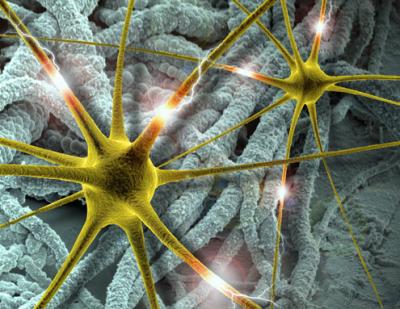
Brain implants that can more clearly record signals from surrounding neurons in rats have been created at the University of Michigan. The findings could eventually lead to more effective treatment of neurological disorders such as Parkinson's disease and paralysis. Neural electrodes must work for time periods ranging from hours to years. When the electrodes are implanted, the brain first reacts to the acute injury with an inflammatory response. Then the brain settles into a wound-healing, or chronic, response.
It's during this secondary response that brain tissue starts to encapsulate the electrode, cutting it off from communication with surrounding neurons.
The new brain implants developed at U-M are coated with nanotubes made of poly(3,4-ethylenedioxythiophene) (PEDOT), a biocompatible and electrically conductive polymer that has been shown to record neural signals better than conventional metal electrodes.
U-M researchers found that PEDOT nanotubes enhanced high-quality unit activity (signal-to-noise ratio >4) about 30 percent more than the uncoated sites. They also found that based on in vivo impedance data, PEDOT nanotubes might be used as a novel method for biosensing to indicate the transition between acute and chronic responses in brain tissue.
The results are featured in the cover article of the Oct. 5 issue of the journal Advanced Materials. The paper is titled, "Interfacing Conducting Polymer Nanotubes with the Central Nervous System: Chronic Neural Recording using Poly(3-4-ethylenedioxythiophene) Nanotubes."
"Microelectrodes implanted in the brain are increasingly being used to treat neurological disorders," said Mohammad Reza Abidian, a post-doctoral researcher working with Professor Daryl Kipke in the Neural Engineering Laboratory at the U-M Department of Biomedical Engineering.
"Moreover, these electrodes enable neuroprosthetic devices, which hold the promise to return functionality to individuals with spinal cord injuries and neurodegenerative diseases. However, robust and reliable chronic application of neural electrodes remains a challenge."
In the experiment, the researchers implanted two neural microelectrodes in the brains of three rats. PEDOT nanotubes were fabricated on the surface of every other recording site by using a nanofiber templating method. Over the course of seven weeks, researchers monitored the electrical impedance of the recording sites and measured the quality of recording signals.
PEDOT nanotubes in the coating enable the electrodes to operate with less electrical resistance than current metal electrode sites, which means they can communicate more clearly with individual neurons.
"Conducting polymers are biocompatible and have both electronic and ionic conductivity," Abidian said. "Therefore, these materials are good candidates for biomedical applications such as neural interfaces, biosensors and drug delivery systems."
In the experiments, the Michigan researchers applied PEDOT nanotubes to microelectrodes provided by the U-M Center for Neural Communication Technology. The PEDOT nanotube coatings were developed in the laboratory of David C. Martin, now an adjunct professor of materials science and engineering, macromolecular science and engineering, and biomedical engineering. Martin is currently the Karl W. Böer Professor and Chair of the Materials Science and Engineering Department at the University of Delaware.
Martin is also co-founder and chief scientific officer for Biotectix, a U-M spinoff company located in Ann Arbor. The company is working to commercialize conducting polymer-based coatings for a variety of biomedical devices
In previous experiments, Abidian and his colleagues have shown that PEDOT nanotubes could carry with them drugs to prevent encapsulation.
"This study paves the way for smart recording electrodes that can deliver drugs to alleviate the immune response of encapsulation," Abidian said.
Source: University of Michigan
Other sources
- Step Toward Better Brain Implants Using Conducting Polymer Nanotubesfrom Science DailyFri, 2 Oct 2009, 15:14:50 UTC
- A step toward better brain implants using conducting polymer nanotubesfrom Science BlogTue, 29 Sep 2009, 21:56:25 UTC
- A step toward better brain implants using conducting polymer nanotubesfrom PhysorgTue, 29 Sep 2009, 21:56:07 UTC