


Second-hand smoking results in liver disease, study finds
Related images
(click to enlarge)
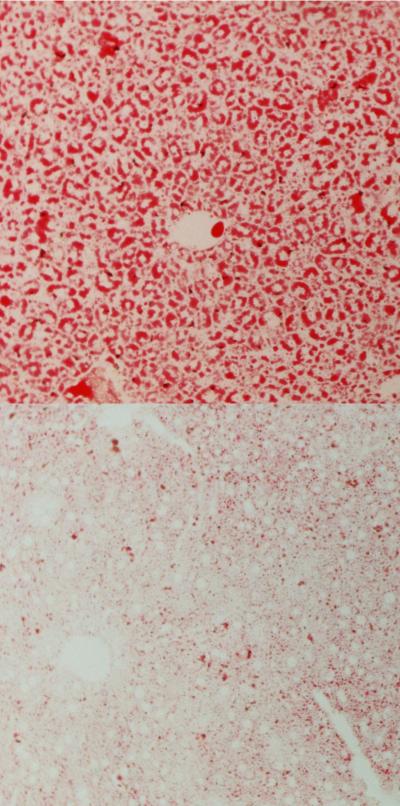
A team of scientists at the University of California, Riverside has found that even second-hand tobacco smoke exposure can result in nonalcoholic fatty liver disease (NAFLD), a common disease and rising cause of chronic liver injury in which fat accumulates in the liver of people who drink little or no alcohol. The researchers found fat accumulated in liver cells of mice exposed to second-hand cigarette smoke for a year in the lab. Such fat buildup is a sign of NAFLD, leading eventually to liver dysfunction.
In their study, the researchers focused on two key regulators of lipid (fat) metabolism that are found in many human cells as well: SREBP (sterol regulatory element-binding protein) that stimulates synthesis of fatty acids in the liver, and AMPK (adenosine monophosphate kinase) that turns SREBP on and off.
They found that second-hand smoke exposure inhibits AMPK activity, which, in turn, causes an increase in activity of SREBP. When SREBP is more active, more fatty acids get synthesized. The result is NAFLD induced by second-hand smoke.
"Our study provides compelling experimental evidence in support of tobacco smoke exposure playing a major role in NAFLD development," said Manuela Martins-Green, a professor of cell biology, who led the study. "Our work points to SREBP and AMPK as new molecular targets for drug therapy that can reverse NAFLD development resulting from second-hand smoke. Drugs could now be developed that stimulate AMPK activity, and thereby inhibit SREBP, leading to reduced fatty acid production in the liver."
Results of the study appear in the September issue of the Journal of Hepatology.
The study emphasizes that discouraging cigarette smoking helps prevent not only cardiovascular disease, pulmonary disease and cancer, but now also liver disease.
Second-hand smoke is the combination of smoke exhaled by a smoker and smoke given off by the burning end of a tobacco product. Lingering in the air long after tobacco products have been extinguished, it is involuntarily inhaled by nonsmokers in the vicinity.
Second-hand smoke is a major toxicant that affects children, the elderly and nonsmokers living in the household of adults who smoke. Many state and local governments have passed laws prohibiting smoking in public facilities. Diseases associated with second-hand smoking include cancer, heart disease, atherosclerosis, pneumonia, bronchitis and severe asthma.
Despite the large body of scientific evidence documenting the effects of passive or active smoking on the heart and lungs, reports investigating how smoking causes liver injury are scant.
"Until our study, second-hand smoking had not been linked to NAFLD development," Martins-Green said.
She was joined in the study by her graduate student Hongwei Yuan (first author of the research paper and now a postdoctoral researcher in her lab) and UC Riverside's John Shyy, a professor of biomedical sciences. Next, the team plans to investigate the clinical relevance of their findings. A grant to Martins-Green from Philip Morris USA, Inc., supported the research.
Source: University of California - Riverside
Articles on the same topic
- Regular aerobic exercise reduces health concerns associated with fatty liverWed, 9 Sep 2009, 14:30:47 UTC
Other sources
- Exercise helps liver directlyfrom Science AlertTue, 15 Sep 2009, 14:14:28 UTC
- Second-hand Smoking Results In Liver Disease, Study Findsfrom Science DailyMon, 14 Sep 2009, 0:07:24 UTC
- Second-hand smoking results in liver disease, study findsfrom Science BlogThu, 10 Sep 2009, 18:56:35 UTC
- Second-hand smoking results in liver disease, study findsfrom PhysorgThu, 10 Sep 2009, 17:56:09 UTC
- Regular aerobic exercise reduces health concerns associated with fatty liverfrom PhysorgWed, 9 Sep 2009, 20:28:06 UTC
- Regular Aerobic Exercise Reduces Health Concerns Associated With Fatty Liverfrom Science DailyWed, 9 Sep 2009, 14:28:11 UTC