


Red List overlooks island species
Related images
(click to enlarge)
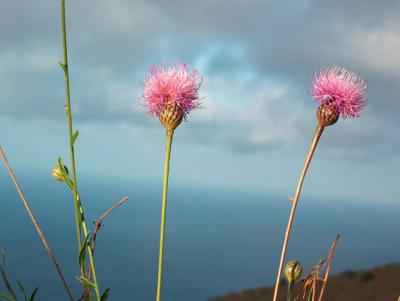
The criteria of the International Union for the Conservation of Nature (IUCN)'s Red List are an essential tool for evaluating the conservation status of species around the planet, and according to these criteria all the species in the Canary Islands are endangered. However, research carried out recently by José Luis Martín Esquivel has highlighted some conflicting areas within the scientific protocol designed to identify threatened plants and animals. José Luis Martín Esquivel, a researcher at the Centre for Environmental Planning (CEPLAM) run by the Government of the Canary Islands, has assessed the conservation status of species that are supposed to be under threat in the Canary Islands according to IUCN criteria. However, the lists of species threatened with extinction according to these criteria did not coincide with reality, as they were "too extensive" and included species that "do not face any risk at all".
After analysing the basis for the Red List criteria, Martín Esquivel discovered that "almost all relate to vertebrates (above all birds) and plants, and they are all based on continental species, not island ones", the author of the study published in the Journal for Nature Conservation tells SINC.
Given the difference between continental and island ecosystems, the scientist says there is a "clear discrepancy". Species on islands are distributed according to the size of the island itself, "and are often found at lower concentrations than similar continental species, without this meaning they should be thought to be threatened", adds Martín Esquivel.
According to the International Union for the Conservation of Nature (IUCN), any species with a distribution area of less than 2,000 km2 should be considered to be threatened. This would mean the 3,672 species endemic to the Canary Islands (38 vertebrates, 510 plants, 2,960 arthropods or invertebrates and 196 molluscs) should be labelled as threatened, because only the largest island of the Canaries, Tenerife, covers an area of around 2,000 km2.
The scientists believes that "many of the more than 4,000 endemic species on the Canary Islands are in a very healthy condition, and are not at any risk whatsoever", although he adds that specific conservation measures are needed as a matter of urgency in order to conserve the unique biodiversity of small islands. In comparison with continents and large islands, small islands operate on a different ecological basis.
Another inconsistency noted in the study is that insects, the most naturally abundant group (accounting for 90% of the almost 4,000 endemic species in the Canary Islands), are not covered by Red List criteria for threatened species. As invertebrates usually have a smaller distribution area than large vertebrates and birds "the same baseline criteria cannot be used for birds and snails, for example", explains the biologist.
"More than 2,000 species, most of which are in a good state of conservation, are island species endemic to the Canary Islands, living in protected areas without any significant threats, and so one cannot conclude that they are at risk", stresses Martín Esquivel, who compares the problem to that in other islands, such as the Galapagos, or larger islands such as New Zealand.
Are small island species in decline?
According to the biologist, the best way to identify whether species on small islands are threatened would be to "stop using the qualitative thresholds system" established by the IUCN, and "find out whether the species is in regression", because a threatened species is one that is losing ground in terms of the area it occupies, or the number of its individuals. Martín Esquivel says "the most important thing is whether the species' home range is decreasing, stable, or expanding".
The researcher suggests rigorously identifying those species that are really threatened. Protecting species means ensuring that "the few resources available for protecting priority species are spent on those really in most urgent need of conservation". "Expending efforts on species that are not threatened simply because they are iconic or because powerful pressure groups are fighting for them does not help efforts to prevent biodiversity loss", the biologist concludes.
Source: FECYT - Spanish Foundation for Science and Technology
Other sources
- Red List overlooks island speciesfrom Science BlogFri, 24 Jul 2009, 15:42:04 UTC
- Red List Evaluating Conservation of Species May Incorrectly Evaluate Island Species' Statusfrom Science DailyFri, 24 Jul 2009, 14:35:07 UTC
- Red List overlooks island speciesfrom PhysorgFri, 24 Jul 2009, 13:21:21 UTC