


Geoscientists from the Alfred Wegener Institute back from an expedition to Labrador Sea
Related images
(click to enlarge)
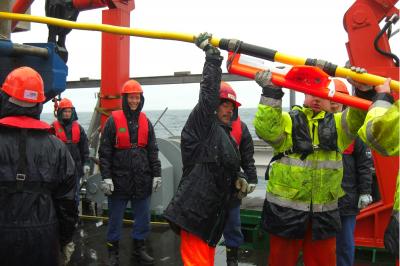

Bremerhaven, July 20th 2009. Scientists from the Alfred Wegener Institute have researched the geology of the seabed in the Labrador Sea on board of the research vessel Maria S. Merian. They have studied the so-called Eirik Drift at the southern tip of Greenland, a structure of several hundred kilometres length formed like a ridge. They discovered a submarine mountain (seamount) at the south-western fringe of their area of investigation that indicates volcanic eruptions during the past few million years. The Eirik Drift rises 2,500 m above the surrounding seabed at the southern tip of Greenland. Sediments have been depositing there for the last ten million years, forming a ridge-like structure. These sediments are ablated by ocean currents in the Greenland Sea and deposited in the Labrador Sea. This is also known to be the case with sand displacements caused by ocean currents, for example on Sylt. Caused by changing climate - the transition from warmer times to our current climate - the current drifted and changed its strength. Additionally, icebergs transport rock material from Greenland onto the seabed. Glaciers planed it off the island, and on breaking apart into icebergs, deposited it all over the ocean. Caused by the constantly expanding and melting ice surface during the geological cycles of glacials and interglacials, this material finds its way into the Eirik Drift, too.
Therefore, the Eirik Drift is an archive for the activity of Greenland's western boundary current and the dynamics of Greenland ice cover. Climate changes and current shifts of the last ten million years can be examined here. First results show that the drift shifted strongly to the North and the West. This event took place about 5.6 million years ago. A sediment drift can be observed for the period prior to that, but velocity and path of the current changed strongly. Researchers will be able to further analyse these data by means of computer models in order to describe these changes in more detail.
The researchers discovered something unexpected during the seismic investigation using a recording cable of 3.000 m length: "Surprisingly, an unknown elevation appeared on the images of the subsurface in the western area of the Eirik Drift, which almost breaks through the sediments to the top of the seabed at two places", reports chief scientist Dr. Gabriele Uenzelmann-Neben from the Alfred Wegener Institute for Polar and Marine Research in the Helmholtz Association. "The sedimentary layers are disturbed", the geophysicist continues. This elevation at the seabed, called Mount Maria S. Merian by the researchers, is about 1.500 m high - approximately as high as the Feldberg in the Black Forest. The seamount was formed by volcanism which pushed sediments upwards. Even the youngest sediment packages are affected by this movement.
It can therefore be concluded that this is a young event have occurred during the last few million years. This result changes the picture of the geological development of the outer part of the Labrador Sea. So far it was assumed that the formation of the seafloor in the Labrador Sea (tectonic activity) ended about 45 million years ago. The discovery of the seamount indicates that the seabed at the exit of the Labrador Sea changed in more recent times. A distinct changing seabed has an enormous impact on the circulation paths of deepwater, which maintains ocean currents like the Gulf Stream.
The expedition of RV Maria S. Merian, operated by the Leitstelle Merian/Meteor of the University of Hamburg, began June 17th 2009 in Reykjavik where it also ended July 13th.
Source: Helmholtz Association of German Research Centres
Other sources
- Indications For Volcanic Eruptions In The Younger Geological History Found In Labrador Seafrom Science DailySat, 25 Jul 2009, 5:14:45 UTC
- Geoscientists from the Alfred Wegener Institute back from an expedition to Labrador Seafrom Science BlogWed, 22 Jul 2009, 14:42:13 UTC
- Geoscientists back from expedition to Labrador Seafrom PhysorgWed, 22 Jul 2009, 14:28:24 UTC