


Quantum memory and turbulence in ultra-cold atoms
Related images
(click to enlarge)
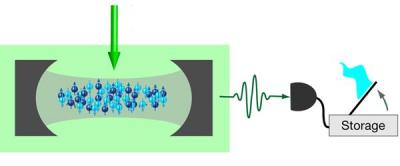
Scientists at MIT have figured out a key step toward the design of quantum information networks. The results are reported in the July 20th issue of Physical Review Letters and highlighted in APS's on-line journal Physics (physics.aps.org). A quantum network – in which memory devices that store quantum states are interconnected with quantum information processing devices – is a prototype for designing a quantum internet. One path to making a quantum network is to map a light pulse onto nodes in a material system. Yet, it is one thing to catch a beam of light; it is more difficult to generate a signal that heralds that it has been successfully caught. Quantum systems follow Heisenberg's rule that observing an event may destroy it, so the system has to emit just the right kind of herald pulse so as not to erase the data.
Now, Haruka Tanji, Saikat Ghosh, Jonathan Simon, Benjamin Bloom, and Vladan Vuletic from MIT have demonstrated an atomic quantum memory that heralds the successful storage of a light beam in a cold atom gas. The atomic-ensemble memory can receive an arbitrary polarization state of an incoming photon, called a polarization qubit, announce successful storage of the qubit, and later regenerate another photon with the same polarization state. The herald signal only announces the fact the pulse has been captured, not details of the polarization, so the quantum information is preserved.
This capability will likely benefit scalable quantum networking, where it is crucial to know if operations have succeeded.
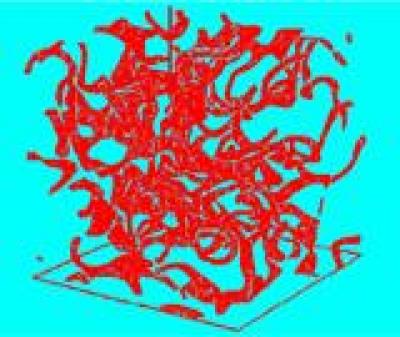
Scientists in Brazil report the controllable formation of quantum turbulence in an ultra-cold atom gas. The results, which appear in the July 20 issue of Physical Review Letters and are highlighted in the APS journal Physics (physics.aps.org) may make it easier to characterize quantum turbulence – and potentially even classical turbulence – because it is possible to tune many characteristics of the cold-atom gas.
Turbulence is considered a nuisance because it slows down boats and jars airplanes. But for hundreds of years, physicists have been fascinated with the notoriously difficult problem of how to describe this phenomenon, which involves the formation and disappearance of vortices – swirling regions in a gas or liquid– over many different length and time scales.
Turbulence can also occur in quantum fluids, such as ultra-cold atom gases and superfluid helium. In a quantum fluid, the motion of the vortices is quantized; and, because quantum fluids have zero viscosity, the vortices cannot easily disappear.
These properties make quantum turbulence more stable and easier to understand than classical turbulence. Now, Emanuel Henn and colleagues at the University of Sao Paulo in Brazil and the University of Florence in Italy have created quantum turbulence in a gas of ultra-cold rubidium atoms by shaking it up with a magnetic field. In this way, they are able to control the formation of vortices and generate many different kinds of turbulence to explore a number of questions relevant to both its quantum and classical forms.
Source: American Physical Society
Other sources
- Key To Designing Quantum Information Networks: Quantum Memory And Turbulence In Ultra-cold Atomsfrom Science DailyMon, 20 Jul 2009, 13:35:20 UTC
- Understanding Quantum Turbulence: Controllable Formation Of Quantum Turbulence In Ultra-cold Atom Gasfrom Science DailyMon, 20 Jul 2009, 13:35:19 UTC
- Quantum memory and turbulence in ultra-cold atomsfrom PhysorgMon, 20 Jul 2009, 7:35:10 UTC
- Quantum memory and turbulence in ultra-cold atomsfrom Science BlogMon, 20 Jul 2009, 4:42:04 UTC