


New lab test offers better prediction of HIV microbicide safety
Related images
(click to enlarge)
Scientists at Albert Einstein College of Medicine of Yeshiva University have devised a laboratory test for predicting whether microbicides against HIV are safe for human use. The researchers have also discovered why several supposedly "safe" microbicides made women more susceptible to HIV infection. The study appears today in the online version of the Journal of Infectious Disease. For years, scientists have been trying to develop a topical vaginal microbicide for preventing transmission of HIV, the virus that causes AIDS. A safe and effective microbicide would help protect women in settings where male condoms are not used — a common situation in many cultures. The need for an HIV microbicide is especially urgent in Africa, where AIDS is the leading cause of death and where women account for six out of ten of those living with HIV.
Several microbicide gels have been assessed in clinical trials after passing laboratory and animal safety tests. But with just one exception, all the microbicides were found to be ineffective against HIV; and two of the gels — nonoxynol-9 and cellulose sulfate — actually increased the risk of HIV infection in women.
"Our goal was to develop assays that are predictive of safety before proceeding to clinical trials that typically cost millions of dollars, involve thousands of women, and take many years," says study leader Betsy C. Herold, M.D., professor of pediatrics, of microbiology & immunology, and of obstetrics & gynecology and women's health at Einstein.
In evaluating a microbicide's safety, researchers look primarily for signs that the chemical inflames cells of the vaginal lining, or epithelium. That could cause more harm than good: When the epithelium becomes inflamed, T cells flock to the damaged area — which might actually encourage HIV infection, since T cells are the main targets of HIV.
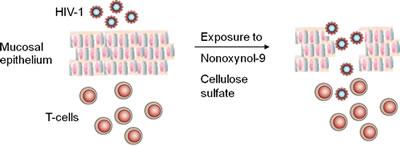
Dr. Herold theorized that another mechanism may also compromise a microbicide's safety. The cells of the vaginal epithelium normally are tightly packed together, forming an impermeable barrier to HIV. If a microbicide disrupts the barrier's structural integrity, HIV would be able to slip through the gaps and infect circulating T cells.
To test this theory, Pedro Mesquita, a postdoctoral fellow in Dr. Herold's lab, developed a model that mimicked the genital tract environment. It was composed of two chambers separated by a barrier of cultured human cells that form tight junctions. After treating the epithelial cells with different microbicides, the researchers tested the barrier's permeability to HIV by placing HIV in the upper chamber, T cells in the lower chamber, and then monitoring the infection of the T cells over time.
When the epithelial barrier was treated with placebo, HIV was unable to pass through to the lower chamber, leaving the T cells uninfected. "But when we applied nonoxynol-9, the virus went right through the barrier and infected the T cells," says Dr. Herold. This result was no surprise, since nonoxynol-9 is a detergent, a class of chemicals known to be disruptive to cells. What was surprising, she says, was to observe the same result with cellulose sulfate ─ a sulfated polymer that is not a detergent and was shown to be safe in all of the other bioassays and in early clinical trials. These findings may explain the unanticipated clinical trial results in which use of cellulose sulfate was associated with an increase in HIV transmission.
The researchers later tested their model on two other microbicide candidates now being evaluated in large-scale clinical efficacy trials. Both drugs — tenofovir and PRO 2000 —performed well by not disrupting the epithelial barrier.
"Our findings strongly suggest that microbicides can increase the risk of HIV infection through a mechanism other that inflammation — namely, by disrupting the protective epithelial cell barrier," says Dr. Herold. "If confirmed by further study, this assay should be used early on to screen for microbicide safety before advancing a product to clinical trials involving thousands of women," she adds.
Dr. Herold is also developing animal models for evaluating microbicides. Since these models use actual epithelial tissue, they could offer even better predictions of microbicide safety.
Source: Albert Einstein College of Medicine
Other sources
- New lab test offers better prediction of HIV microbicide safetyfrom Biology News NetSat, 11 Jul 2009, 1:56:10 UTC
- New lab test offers better prediction of HIV microbicide safetyfrom PhysorgFri, 10 Jul 2009, 15:07:19 UTC