


Scientists closer to developing salt-tolerant crops
Related images
(click to enlarge)
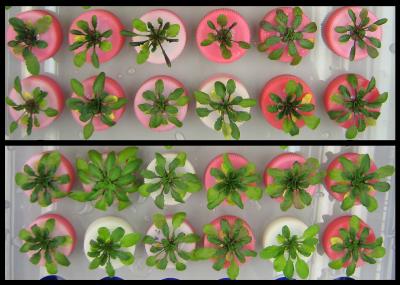

An international team of scientists has developed salt-tolerant plants using a new type of genetic modification (GM), bringing salt-tolerant cereal crops a step closer to reality. The research team – based at the University of Adelaide's Waite Campus in Australia – has used a new GM technique to contain salt in parts of the plant where it does less damage.
Salinity affects agriculture worldwide, which means the results of this research could impact on world food production and security.
The work has been led by researchers from the Australian Centre for Plant Functional Genomics and the University of Adelaide's School of Agriculture, Food and Wine, in collaboration with scientists from the Department of Plant Sciences at the University of Cambridge, UK.
The results of their work are published today in the top international plant science journal, 'The Plant Cell'.
"Salinity affects the growth of plants worldwide, particularly in irrigated land where one third of the world's food is produced. And it is a problem that is only going to get worse, as pressure to use less water increases and quality of water decreases," says the team's leader, Professor Mark Tester, from the School of Agriculture, Food and Wine at the University of Adelaide and the Australian Centre for Plant Functional Genomics (ACPFG).
"Helping plants to withstand this salty onslaught will have a significant impact on world food production."
Professor Tester says his team used the technique to keep salt – as sodium ions (Na+) – out of the leaves of a model plant species. The researchers modified genes specifically around the plant's water conducting pipes (xylem) so that salt is removed from the transpiration stream before it gets to the shoot.
"This reduces the amount of toxic Na+ building up in the shoot and so increases the plant's tolerance to salinity," Professor Tester says.
"In doing this, we've enhanced a process used naturally by plants to minimize the movement of Na+ to the shoot. We've used genetic modification to amplify the process, helping plants to do what they already do – but to do it much better."
The team is now in the process of transferring this technology to crops such as rice, wheat and barley.
"Our results in rice already look very promising," Professor Tester says.
Source: University of Adelaide
Other sources
- Gene tweak helps salt survivalfrom Science AlertWed, 8 Jul 2009, 12:28:16 UTC
- Scientists Closer To Developing Salt-tolerant Cropsfrom Science DailyWed, 8 Jul 2009, 3:28:25 UTC
- Scientists Closer to Developing Salt-tolerant Cropsfrom Newswise - ScinewsTue, 7 Jul 2009, 18:49:04 UTC
- Scientists closer to developing salt-tolerant cropsfrom PhysorgTue, 7 Jul 2009, 18:28:53 UTC