


College science requirements keep US ahead of world, MSU researcher argues
Related images
(click to enlarge)
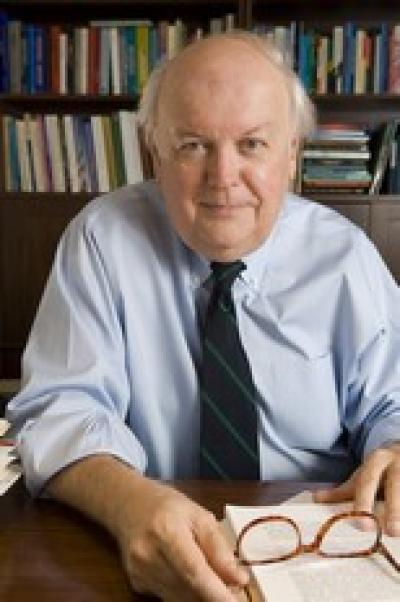
Despite frequent warnings of the inadequacy of education in the United States, citizens here are still among the world's most scientifically literate, a Michigan State University researcher said. You can thank those general education requirements that force English majors to sit through biology classes and budding engineers to read Hemingway, Jon Miller said.
Miller, the John A. Hannah Professor of integrative studies and director of the International Center for the Advancement of Scientific Literacy at MSU, for many years has conducted social research on scientific literacy around the world. He summarized his findings at the American Association for the Advancement of Science annual meeting in Chicago at a C.P. Snow retrospective symposium today.
Fifty years after English novelist and physicist C.P. Snow warned of a disturbing lack of scientific literacy among the cultural elite and a parallel literary void among Britain's scientists and technologists, little has changed in most of the world, Miller argued. And that's part of what keeps the U.S. at the forefront of scientific endeavor and technological innovation.
"What makes the American market and society different," he said, "is that we have more science- and technology-receptive citizens and consumers, and as a society we're willing to spend money for basic science and have been doing that for years."
Americans as a group tend to be more open-minded about innovations such as genetically modified food, he said. Scientific reasoning also works its way into such disciplines as law, he noted, where facts are routinely marshaled to support or disprove theories. And faith in scientific progress might even make people more optimistic overall, with effects spilling over into politics and other realms.
That being said, Miller's research over the years has revealed what he describes as a general lack of scientific knowledge overall. Most adults in the United States and Europe, he said, don't have a sufficient understanding of important issues facing society, issues such as stem cell research. Americans, he found in 2006, are less likely to accept evolution than Europeans – a third of U.S. citizens surveyed reject the concept.
Snow sparked debate in a 1959 lecture, "The Two Cultures," a discussion that continues today. As post-war technological advances took greater prominence in society, he lamented the divide between the leading lights of British science and the humanities. It's an issue with pronounced relevance overseas, Miller said, given the relatively narrow educational paths afforded by higher education there.
"An engineer in Europe is an engineer, and that's all they know," he asserted. "That's all you study."
The general education requirements common to most American colleges and universities, in contrast, add a year of broader education to the curriculum. That, he added, is a critical patch to what he describes as a woefully underperforming high school educational system and an increasingly complex world.
"If you don't have a clue about how the solar system or universe is organized, the 21st century is going to be very strange to you," he said.
At MSU, science requirements for nonmajors aren't the only manifestation of the Snow critique. The university's science residential college curriculum embodies the principle.
"Briggs was founded explicitly to bridge the gap that C.P. Snow identified," said Lyman Briggs College Professor Robert T. Pennock, a noted science advocate. "We really believe that our students will be better scientists to the extent that they also become fluent in the humanities."
"Our courses in science and mathematics not only introduce the topics and methods of a particular field, but also demonstrate the interrelation of the various scientific disciplines: how chemical principles underpin biological processes, how mathematical models can make sense of physical behaviors," said Briggs Dean Elizabeth Simmons. "At the same time, our courses in the history, philosophy and sociology of science draw students into analyzing the way scientists think about questions in their own disciplines, and how academics from other fields evaluate the methods and conclusions of science."
Source: Michigan State University
Other sources
- College science requirements keep US ahead of worldfrom Science BlogMon, 16 Feb 2009, 22:07:11 UTC
- College Science Requirements Keep US Ahead Of World, Researcher Arguesfrom Science DailyMon, 16 Feb 2009, 19:35:15 UTC
- College science requirements keep US ahead of world, MSU researcher arguesfrom PhysorgMon, 16 Feb 2009, 19:28:18 UTC
- College science requirements keep US ahead of worldfrom Science BlogMon, 16 Feb 2009, 17:56:39 UTC