


New reference material can improve testing of multivitamin tablets
Related images
(click to enlarge)
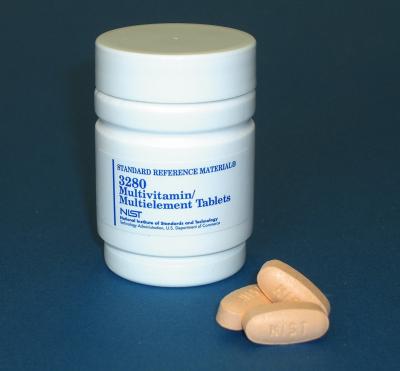
The National Institute of Standards and Technology (NIST) has developed a new certified reference material that can be an important quality assurance tool for measuring the amounts of vitamins, carotenoids, and trace elements in dietary supplements. The new Standard Reference Material (SRM) 3280 for multivitamin/multimineral tablets was created in collaboration with the Office of Dietary Supplements (ODS) at the National Institutes of Health (NIH). Demand from a growing number of Americans concerned that they are not getting all the prescribed nutrients from their food has created a multibillion-dollar dietary supplement industry. Although manufacturers have their own testing methods and materials to ensure that their products contain the nutrients in the amounts listed on their labels, they have had no definitive, independently certified standard with which to verify their testing methods and calibrate their equipment. The new reference standard will help fill that gap.
A manufacturer of multivitamin/multimineral tablets prepared the source material for SRM 3280 as a non-commercial batch of tablets according to their normal procedures. NIST scientists tested and certified the concentrations of 24 elements and 17 vitamins and carotenoid compounds in the tablets.
“We are not saying what a product should contain, but what it does contain,” Sharpless said. “Our SRMs are intended for analytical chemists to use to make sure their methods are working properly, not a benchmark for what a good product should be.”
SRM 3280 is part of a larger ongoing effort the NIST group has undertaken to develop reference materials for fatty acids, caffeine, and a whole host of other dietary supplements including ginkgo, saw palmetto, and bitter orange, and others as they appear on store shelves.
The SRM will also be used to support the efforts of the ODS and the U.S. Department of Agriculture in developing accurate data for the Dietary Supplement Ingredient Database (DSID). Researchers in the academic community will also be able to use the SRM to benchmark their assays for vitamins and minerals just as other SRMs are used to standardize serum cholesterol measurements.
Source: National Institute of Standards and Technology (NIST)
Other sources
- New Reference Material Can Improve Testing Of Multivitamin Tabletsfrom Science DailyWed, 11 Feb 2009, 17:22:27 UTC
- New reference material can improve testing of multivitamin tabletsfrom PhysorgWed, 11 Feb 2009, 16:42:23 UTC
- New Reference Material Can Improve Testing of Multivitamin Tabletsfrom Newswise - ScinewsWed, 11 Feb 2009, 1:42:22 UTC