


'Birth control' for centrioles
Related images
(click to enlarge)
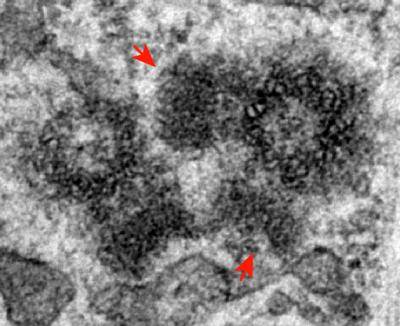
Like DNA, centrioles need to duplicate only once per cell cycle. Rogers et al. uncover a long-sought mechanism that limits centriole copying, showing that it depends on the timely demolition of a protein that spurs the organelles' replication. The study will appear in the January 26, 2009 issue of the Journal of Cell Biology and online at www.jcb.org.
Centrioles start reproducing themselves during G1 or S phase. What prevents the organelles from xeroxing themselves again and again has puzzled researchers for more than a decade. The process could be analogous to the mechanism for controlling DNA replication. There, a licensing factor preps the DNA for duplication. During DNA synthesis, the factor gets tagged with ubiquitin molecules that prompt its destruction, thus preventing another round of copying.
To determine whether a similar mechanism keeps centrioles in check, Rogers et al. blocked Drosophila cells' production of different proteins that combine to form a ubiquitin-adding complex. Loss of one of these proteins, Slimb, allowed cells to fashion extra centrioles, the researchers found.
Slimb's target, the team showed, is the enzyme Plk4, which sports a Slimb-binding motif. Plk4 levels on the centrioles peaked during mitosis, and the enzyme vanished from the organelles by S phase. However, a mutant form of Plk4 that Slimb couldn't latch onto clung to the centrioles throughout the cell cycle and caused their over-duplication.
Plk4 serves as a licensing factor for centriole copying, Rogers et al. suggest. During mitosis, it sets the stage for the next cell division by phosphorylating an unidentified protein (or proteins) that will later instigate centriole duplication. Slimb and its protein partners then ubiquitinate Plk4, so that no enzyme remains on the centrioles by the time they are ready for copying. Thus, the organelles are duplicated once only. Tumor cells often bypass the limit on centriole duplication, and the work suggests that drugs to restrict the organelles' replication might hold promise as cancer treatments.
Source: Rockefeller University Press
Other sources
- 'Birth Control' For Centriolesfrom Science DailyTue, 27 Jan 2009, 17:42:49 UTC
- 'Birth control' for centriolesfrom PhysorgMon, 26 Jan 2009, 17:28:20 UTC