


New stretchable electrodes created to study stresses on cardiac cells
Related images
(click to enlarge)
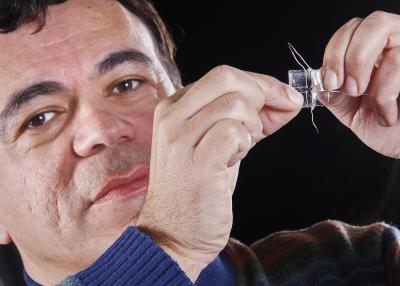
Engineers at Purdue and Stanford universities have created stretchable electrodes to study how cardiac muscle cells, neurons and other cells react to mechanical stresses from heart attacks, traumatic brain injuries and other diseases. The devices are made by injecting a liquid alloy made of indium and gallium into thin microchannels between two sheets of a plastic polymer, said Babak Ziaie, a Purdue associate professor of electrical and computer engineering.
Cell cultures are grown on top of the new "stretchable cell culture platform."
"We designed a simple and cost-effective process for fabricating these stretchable platforms," said Ziaie, who is working with Beth L. Pruitt, an assistant professor of mechanical engineering at Stanford, along with graduate students and other researchers at both universities. "What's special about this technology is that it allows you to electrically stimulate or monitor the cell population using electrodes while you are applying stress to the cells."
Stretching the cell cultures causes mechanical stresses like those exerted on tissues during heart attacks and traumatic brain injuries. The researchers have grown mice cardiac muscle cells on the platform and may grow cell cultures of neurons in future work. Cultures of stem cells also could be tested using the system to determine how mechanical stresses prompt the cells to differentiate into specific types of tissues, Ziaie said.
"You cannot stretch solid metal beyond a few percent because it will break, but we've been able to stretch these liquid platforms more than 40 percent of their original size," Ziaie said.
Findings are detailed in a paper being presented Monday (Jan. 26) during the 22nd IEEE International Conference on Micro Electro Mechanical Systems. The conference, sponsored by the Institute of Electrical and Electronics Engineers, will be in Sorrento, Italy.
"We demonstrated that the platform is biocompatible with human aortic muscle cells and mice heart cells," Ziaie said. "The cells adhered well to the polymer surface during mechanical strain and survived near and on the electrodes after two days of incubation. The platform also maintained its electrical capabilities after being stretched 100 times."
Purdue researchers designed and fabricated the platform at the Birck Nanotechnology Center in Purdue's Discovery Park. Stanford researchers grew cardiac muscle cell cultures on the device and tested the platform.
"We now hold the record for how much you can stretch an electrical conductor," Ziaie said.
Source: Purdue University
Other sources
- New Stretchable Electrodes Created To Study Stresses On Cardiac Cellsfrom Science DailyThu, 22 Jan 2009, 22:35:29 UTC
- Stretchable electrodes are developedfrom UPIThu, 22 Jan 2009, 19:14:51 UTC
- New stretchable electrodes created to study stresses on cardiac cellsfrom PhysorgThu, 22 Jan 2009, 18:28:21 UTC