


Sensor in artery measures blood pressure
Related images
(click to enlarge)
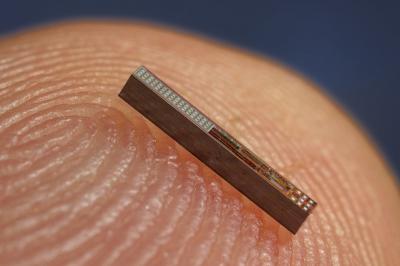
If a person's blood flows through their arteries at too high a pressure, even when they are lying still on the sofa, they could be in danger. High blood pressure causes the heart to constantly pump at full speed, which strains both the heart and vessel walls. Drugs can provide relief, but in many cases the patient's blood pressure is still difficult to regulate and has to be consistently monitored over a long period of time. This is a tedious process: Patients have to wear a small case containing the blood pressure meter close to their body. An inflatable sleeve on their arm records their blood pressure values, for which it is regularly pumped up and deflated. This is a burden on the patients, particularly at night. The whole process is now due to become easier thanks to a tiny implant that could replace the current method. It is being developed by Fraunhofer researchers together with the company Dr. Osypka GmbH and other partners in a BMBF-funded project called "Hyper-IMS" (Intravascular Monitoring System for Hypertension Patients). "A doctor introduces the pressure sensor directly into the femoral artery in the groin," explains head of department Dr. Hoc Khiem Trieu of the Fraunhofer Institute for Microelectronic Circuits and Systems IMS in Duisburg. "The sensor, which has a diameter of about one millimeter including its casing, measures the patient's blood pressure 30 times per second. It is connected via a flexible micro-cable to a transponder unit, which is likewise implanted in the groin under the skin. This unit digitizes and encodes the data coming from the micro-sensor and transmits them to an external reading device that patients can wear like a cell phone on their belt. From there, the readings can be forwarded to a monitoring station and analyzed by the doctor." Because the researchers use special components in CMOS technology, the system requires little energy. The micro-implants can be supplied with electricity wirelessly via coils.
Implantable pressure sensors are also suitable for other applications, such as monitoring patients suffering from cardiac insufficiency. The researchers are currently performing the first clinical trials.
Source: Fraunhofer-Gesellschaft
Articles on the same topic
- Blood pressure test reveals heart disease risk in patients with early stages of CKDWed, 28 Jan 2009, 22:37:53 UTC
- Cutting salt isn't the only way to reduce blood pressureMon, 26 Jan 2009, 22:21:47 UTC
Other sources
- Blood pressure test reveals heart disease risk in patients with early stages of CKDfrom PhysorgWed, 28 Jan 2009, 22:56:24 UTC
- Reducing Salt Intake Isn't The Only Way To Reduce Blood Pressurefrom Science DailyWed, 28 Jan 2009, 14:29:32 UTC
- Cutting salt isn't the only way to reduce blood pressurefrom PhysorgMon, 26 Jan 2009, 22:21:14 UTC
- Sensor In Artery Measures Blood Pressurefrom Science DailyMon, 19 Jan 2009, 14:21:38 UTC
- Common blood pressure drugs should not be combined, doctors urgefrom CBC: HealthFri, 16 Jan 2009, 16:07:06 UTC