


New NIST method accelerates stability testing of soy-based biofuel
Related images
(click to enlarge)
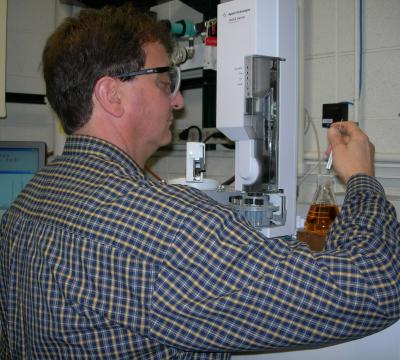
The National Institute of Standards and Technology (NIST) has developed a method to accelerate stability testing of biodiesel fuel made from soybeans and also identified additives that enhance stability at high temperatures. The results, described in a new paper,* could help overcome a key barrier to practical use of biofuels. Both oxidation and heating can cause biodiesel to break down, adversely affecting performance. These two effects usually are analyzed separately, but NIST chemists developed a method to approximate both effects at the same time while also analyzing fluid composition. NIST’s “advanced distillation curve” method could accelerate and simplify testing of biodiesels, according to lead author Tom Bruno. NIST researchers used the new method to demonstrate the effectiveness of three additives in reducing oxidation of biodiesel at high temperatures, as would occur in aviation fuels.
Biodiesel—which can be prepared from vegetable oil, animal fats, used cooking oil, or microalgae—is a potential replacement or extender for petroleum-based diesel fuel. Biodiesel offers several advantages, including renewability, the potential for domestic production, biodegradability, and decreased emissions of carbon monoxide and particulate matter. Biodiesel also has several serious disadvantages, including increased nitrogen oxide emissions and chemical instability, especially at higher temperatures.
Antioxidants often are added to vegetable oils to retard oxidation during storage. The NIST work may be the first to enhance stability of biofuel at high temperatures, Bruno said. The study focused on three compounds, THQ, t-decalin and tetralin,** that help neutralize highly reactive “free radicals” formed at temperatures above 300 degrees C. Test results showed that all three compounds stabilized biodiesel. As expected from studies of aviation fuels, THQ and t-decalin perform similarly and outperform tetralin. For solutions containing 1 percent additive, THQ performed best overall.
A distillation curve charts the percentage of a mixture that evaporates as a sample is slowly heated. Because the different components of a complex mixture typically have different boiling points, a distillation curve gives a good measure of the relative amount of each component. NIST chemists enhanced the traditional technique by improving precision and control of temperature measurements and adding the capability to analyze the chemical composition of each boiling fraction.
To adapt the method for unstable fluids such as biodiesels, the authors made repeated distillation curves of samples and quantified the variation in parameters such as temperature for each distillate fraction across the different runs of the experiment. These data were averaged over the entire distillation curve to identify the range of variations that might occur. This range was extended to theoretically model the potential oxidative and thermal decomposition of the samples.
Source: National Institute of Standards and Technology (NIST)
Other sources
- New Method Accelerates Stability Testing of Soy-Based Biofuelfrom Newswise - ScinewsFri, 16 Jan 2009, 15:36:03 UTC
- New Method Accelerates Stability Testing Of Soy-based Biofuelfrom Science DailyFri, 16 Jan 2009, 2:35:43 UTC
- New Method Accelerates Stability Testing of Soy-Based Biofuelfrom Newswise - ScinewsTue, 13 Jan 2009, 23:28:44 UTC
- New method accelerates stability testing of soy-based biofuelfrom PhysorgTue, 13 Jan 2009, 22:21:46 UTC