


UT Southwestern scientists identify 'border patrol agents' in the gut
Related images
(click to enlarge)
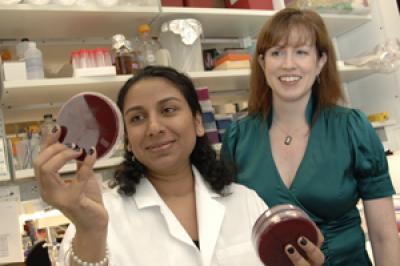
Researchers at UT Southwestern Medical Center have shown in mice how and under what circumstances the gut activates its defensive mechanisms to prevent illness. Scientists have known for decades that microbial cells in the human gut outnumber the body's own cells by about 10 to 1. Some microbes are beneficial, helping us break down food we can't otherwise digest; others can cause disease and illnesses such as food poisoning if they escape the gut and invade body tissues.
The new findings, appearing in an upcoming issue of the Proceedings of the National Academy of Sciences and currently available online, show for the first time that the Paneth cells, which line the guts of mammals, including humans, play a major role in making sure that bacteria – both good and bad types – remain in the right places.
"They're basically border patrol agents," said the study's senior author, Dr. Lora Hooper, assistant professor of immunology and microbiology and an investigator for the Howard Hughes Medical Institute at UT Southwestern.
The findings of the study might offer researchers new clues about the pathologic features of inflammatory bowel diseases, a group of chronic disorders in which the intestines become inflamed.
Dr. Hooper's research team studied mice genetically engineered to lack Paneth cells, which are found in the small intestine and secrete antimicrobial proteins when exposed to bacteria. They then injected Salmonella typhimurium, a strain of Salmonella, into mice both with and without the Paneth cells.
"We found that in the mice lacking Paneth cells, more harmful bacteria were able to spread into the lymph nodes, the spleen and other tissues," said Dr. Shipra Vaishnava, lead author of the study and postdoctoral research fellow in immunology at UT Southwestern.
The mice lacking Paneth cells didn't die, but they generally were sicker than those with Paneth cells. Dr. Vaishnava said the mice lacking Paneth cells most likely didn't become sicker than they did because other epithelial cells, or cells that line many parts of the human body, helped ward off illness.
"Our study also has shown that Paneth cells directly sense bacteria that get too close to the epithelial surface, resulting in the secretion of antimicrobial proteins that help to keep pathogens like Salmonella from invading vulnerable tissue and causing illness," Dr. Vaishnava said.
While their findings indicate that Paneth cells are essential for the function of the epithelium, or gut lining, Dr. Hooper said that Paneth cells most likely exemplify how other epithelial cells function in the gut to prevent illness.
Earlier studies had found that some antimicrobial proteins produced by Paneth cells are activated only when bacteria are present. What remained unclear, though, was whether Paneth cells sensed the bacteria directly or whether other cells were involved. How this defensive mechanism protected the host was also unknown.
"What we want to see now is whether these epithelial cells are also talking to other immune cells deeper inside the tissue," Dr. Hooper said. "Since we now know that epithelial cells are in a dialogue with the bacteria, the next step is to determine if they relay information to other cells further downstream."
Source: UT Southwestern Medical Center
Other sources
- 'Border Patrol Agents' Identified In The Gutfrom Science DailyTue, 9 Dec 2008, 14:20:04 UTC
- Scientists identify 'border patrol agents' in the gutfrom PhysorgMon, 8 Dec 2008, 23:08:25 UTC
- Scientists Identify 'Border Patrol Agents' in the Gutfrom Newswise - ScinewsMon, 8 Dec 2008, 22:21:16 UTC