


Brain reorganizes to adjust for loss of vision
Related images
(click to enlarge)
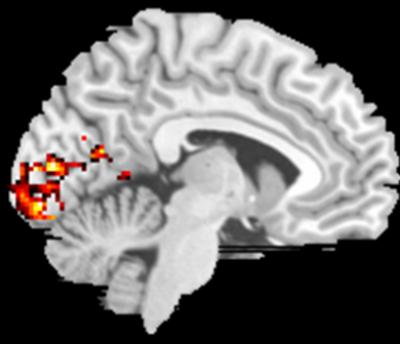
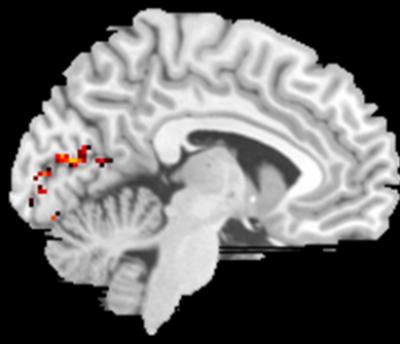
A new study from Georgia Tech shows that when patients with macular degeneration focus on using another part of their retina to compensate for their loss of central vision, their brain seems to compensate by reorganizing its neural connections. Age–related macular degeneration is the leading cause of blindness in the elderly. The study appears in the December edition of the journal Restorative Neurology and Neuroscience. "Our results show that the patient's behavior may be critical to get the brain to reorganize in response to disease," said Eric Schumacher, assistant professor in Georgia Tech's School of Psychology. "It's not enough to lose input to a brain region for that region to reorganize; the change in the patient's behavior also matters."
In this case, that change of behavior comes when patients with macular degeneration, a disease in which damage to the retina causes patients to lose their vision in the center of their visual field, make up for this loss by focusing with other parts of their visual field.
Previous research in this area showed conflicting results. Some studies suggested that the primary visual cortex, the first part of the cortex to receive visual information from the eyes, reorganizes itself, but other studies suggested that this didn't occur. Schumacher and his graduate student, Keith Main, worked with researchers from the Georgia Tech/Emory Wallace H. Coulter Department of Biomedical Engineering and the Emory Eye Center. They tested whether the patients' use of other areas outside their central visual field, known as preferred retinal locations, to compensate for their damaged retinas drives, or is related to, this reorganization in the visual cortex.
The researchers presented 13 volunteers with a series of tests designed to visually stimulate their peripheral regions and measure brain activity with functional magnetic resonance imaging. They found that when patients visually stimulated the preferred retinal locations, they increased brain activity in the same parts of the visual cortex that are normally activated when healthy patients focused on objects in their central visual field. They concluded that the brain had reorganized itself.
The parts of the visual cortex that process information from the central visual field in patients with normal vision were reprogrammed to process information from other parts of the eye, parts that macular degeneration patients use instead of their central visual areas.
While there is evidence with other tasks that suggests that the brain can reorganize itself, this is the first study to directly show that this reorganization in patients with retinal disease is related to patient behavior.
The research group is currently studying how long this reorganization takes and whether it can be fostered through low-vision training.
Source: Georgia Institute of Technology
Other sources
- Brain Reorganizes To Adjust For Loss Of Visionfrom Science DailyThu, 20 Nov 2008, 23:42:14 UTC
- Brain reorganizes to adjust for loss of visionfrom PhysorgThu, 20 Nov 2008, 19:35:34 UTC
- Brain Reorganizes to Adjust for Loss of Visionfrom Science BlogThu, 20 Nov 2008, 18:42:07 UTC
- Potential New Biomarker Of Age-related Macular Degeneration Foundfrom Science DailyMon, 17 Nov 2008, 18:56:50 UTC