


Texas A&M anthropologist discovers long-lost primate in Indonesia
Related images
(click to enlarge)
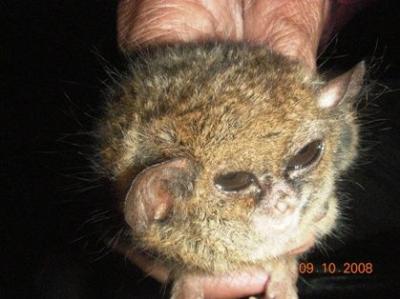
A team led by a Texas A&M University anthropologist has discovered a group of primates not seen alive in 85 years. The pygmy tarsiers, furry Furby/gremlin-looking* creatures about the size of a small mouse and weighing less than 2 ounces, have not been observed since they were last collected for a museum in 1921. Several scientists believed they were extinct until two Indonesian scientists trapping rats in the highlands of Sulawesi accidentally trapped and killed a pygmy tarsier in 2000. Sharon Gursky-Doyen, working with one of her graduate students, Nanda Grow, and a team of locals trapped three of the nocturnal creatures in Indonesia in late August. The pygmy tarsiers possess fingers with claws instead of nails, which Gursky-Doyen says is a distinguishing feature of this species, and distinguishes them from nearly all other primates which have nails and not claws. The claws may be an adaptation to the mossy environment, she believes.
Gursky-Doyen's research was funded by National Geographic Society, Conservation International Primate Action Fund, Primate Conservation Incorporated and Texas A&M University.
Over a two-month period, two males and one female were trapped on Mt. Rore Katimbo in Lore Lindu National Park in Central Sulawesi, Indonesia. The scientists used approximately 276 mist nets to capture the creatures, then attached radio collars to their necks so they could track their movements.
The moist mountainous terrain at heights of 7,000 to 8,000 above sea level proved tricky to navigate, and the nocturnal nature of the animals added another element of danger.
"It was always foggy and wet, so you had to be careful not to get hypothermia," Gursky-Doyen says. "And the moss was so slippery, we were always struggling to stay upright."
Gursky-Doyen, a physical anthropologist, specializes in the behavioral ecology and conservation of the non-human primates. In addition to research on the spectral tarsier, Gursky-Doyen's earlier research focuses on the unusual infant caretaking behaviors exhibited by this primate, as well as the relationship between behavior and lunar cycles. Her most recent research project involves the relationship between group living and ecological pressures such as predation and the temporal distribution of resources.
Gursky-Doyen, who began work on her dissertation in 1993 in the central part of Indonesia, says she is eager to return to gain more first-hand knowledge about the creatures and work toward their preservation. She would like her graduate student, Nanda Grow, whom she calls "a mountain goat, because she was a stronger walker than the other field assistants," to return to the site to complete here dissertation research.
Gursky-Doyen and Grow are drafting a paper that represents the first behavioral and ecological data on this living population of pygmy tarsiers.
Whatever else happens, Gursky-Doyen says she hopes the tarsiers won't slip back into oblivion. Hopefully, she says, now that the Indonesian government knows where this species resides, it will protect them from the encroaching development that is occurring in the range of this species within Lore Lindu National Park.
"There are still primates waiting to be discovered in Indonesia," she says. "Not all have been seen, heard and described."
Source: Texas A&M University
Other sources
- Long-lost 'Furby-like' Primate Discovered In Indonesiafrom Science DailyWed, 19 Nov 2008, 1:49:17 UTC
- Tiny, long-lost primate rediscovered in Indonesiafrom Reuters:ScienceTue, 18 Nov 2008, 23:49:07 UTC
- Pygmy tarsiers, thought extinct, foundfrom UPITue, 18 Nov 2008, 21:21:14 UTC
- Anthropologists discover long-lost primate in Indonesiafrom PhysorgTue, 18 Nov 2008, 18:14:15 UTC
- PHOTO IN THE NEWS: "Extinct" Primate Found in Indonesiafrom National GeographicMon, 17 Nov 2008, 21:35:16 UTC