


Accretion discs show their true colors
Related images
(click to enlarge)
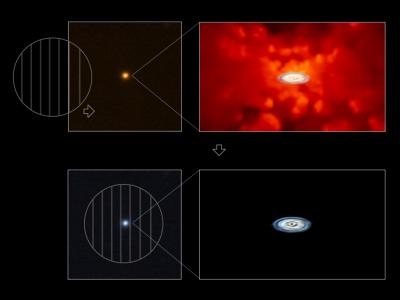
Quasars are the brilliant cores of remote galaxies, at the hearts of which lie supermassive black holes that can generate enough power to outshine the Sun a trillion times. These mighty power sources are fuelled by interstellar gas, thought to be sucked into the hole from a surrounding 'accretion disc'. A paper in this week's issue of the journal Nature, partly based on observations collected with ESO's Very Large Telescope, verifies a long-standing prediction about the intensely luminous radiation emitted by these accretion discs. "Astronomers were puzzled by the fact that the best models of these discs couldn't quite be reconciled with some of the observations, in particular, with the fact that these discs did not appear as blue as they should be," explains lead-author Makoto Kishimoto.
Such a discrepancy could be the signal that there was something very wrong with the models. With his colleagues, he investigated this discrepancy by studying the polarised light from six quasars. This enabled them to demonstrate that the disc spectrum is as blue as predicted.
"The crucial observational difficulty here has been that the disc is surrounded by a much larger torus containing hot dust, whose light partly outshines that of the disc," says Kishimoto. "Because the light coming from the disc is scattered in the disc vicinity and thus polarised, by observing only polarised light from the quasars, one can uncover the buried light from the disc."
In a similar way that a fisherman would wear polarised sunglasses to help get rid of the glare from the water surface and allow him to see more clearly under the water, the filter on the telescope allowed the astronomers to see beyond surrounding clouds of dust and gas to the blue colour of the disc in infrared light.
The observations were done with the FORS and ISAAC instruments on one of the 8.2-m Unit Telescopes of ESO's Very Large Telescope, located in the Atacama Desert, in Chile, as well as several other telescopes, including STFC's UKIRT.
The standard picture of the accretion disc is therefore vindicated. The authors believe that further measurements could eventually provide valuable insight into how and where the disc ends, and how material is being supplied to the disc.
Source: ESO
Articles on the same topic
- Polarized sunglasses see black hole disksThu, 24 Jul 2008, 14:07:38 UTC
- Polarizing filter allows astronomers to see disks surrounding black holesWed, 23 Jul 2008, 18:28:31 UTC
Other sources
- Astronomers See Disks Surrounding Black Holes, Strengthened Evidence For Current Explanation Of Quasarsfrom Science DailyThu, 24 Jul 2008, 2:21:11 UTC
- Polarizing filter allows astronomers to see disks surrounding black holesfrom Science BlogWed, 23 Jul 2008, 19:49:03 UTC
- Polarizing filter allows astronomers to see disks surrounding black holesfrom PhysorgWed, 23 Jul 2008, 18:28:07 UTC